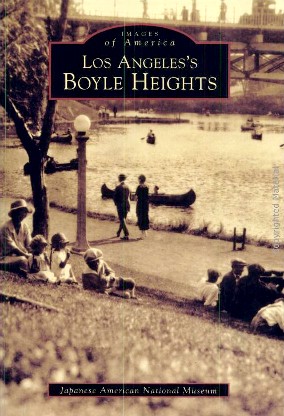
The
cover shows Hollenbeck Park pond, south of the boat
house, looking at the original wooden bridge (downtown
LA in background), beyond which today is the Golden
State Freeway (I-5).
This 2005 book produced
by the Japanese American Museum documents most of the
exhibit: "Boyle
Heights: The Power of Place" from September 8, 2002 to
February 23, 2003. A section of that exhibit was about
LA Molokan-Jumpers: Boyle Heights Project — "Russian
flats". with 45
items showing American Dukh-i-zhizniki (76 people, 37
photos, 5 texts, 2 videos, 1 CD singing). Though many
photos were loaned from the UMCA Heritage Room for
this exhibit, unfortunately none were allowed to be
published in this book due to fears by some zealots on
the UMCA board of directors about disobeying a
prophesy to hide from the world. |
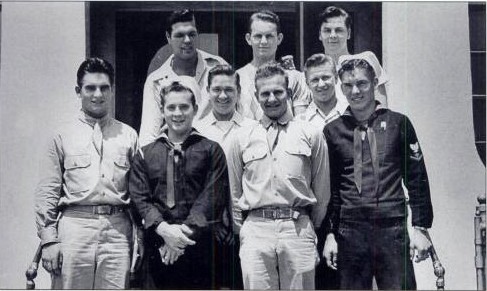
Dukh-i-zhiznik
Molokan
conscientious objectors and servicemen gather at the United Dukh-i-zhiznik
Molokan Christian Association
on Utah
Street in 1943. Shown, from left to right, are (first
row) Andy Patapoff,
Eddy Leigh [Leige], Paul Vedenoff, and
Paul Patapoff;
(second row) Alex Shubin, and John Mendrin;
(third row) Bill Haproff, John Pavloff, and
Al Romanoff.
Russian Pryguny Molokans,
Spiritual Christians
a sect
that broke away from the Russian Orthodox Church under
tsarist Russia and
transformed into Dukh-i-zhiniki in Southern
California, were faced with a difficult
choice during World War II. Committed pacifists, many
Spiritual
Christians Molokans originally fled
Russia to
avoid being conscripted into military service during
the Russo-Janaese war. Nevertheless, young Dukh-i-zhiznik
Molokan
men, including Andy and Paul Patapoff, chose to serve
in the United States military. Despite his request for
non-combatant duty, Andy was assigned to a tank
destroyer battalion in the Pacific Theater. Paul
served in the navy. Some Dukh-i-zhizniki
Molokans, like their
friends Alex Shubin and John Pavloff, were designated
conscientious objectors by their draft boards and
served at the Three
Rivers, California, civilian public service
camps.
Others who were denied conscientious objector status
were sent to prison for refusing to serve in the
military. (Courtesy Paul and Andy Patapoff, Japanese
American National Museum, 2000.211.4.)
|