Book
Review:
by Dr. Joyce Story — Canadian
Slavonic
Papers, Jun-Sep 2001 |
|
| Leo Tolstoy and Fedor
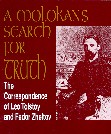
Zheltov. A Molokan's Search for Truth: The
Correspondence of Leo Tolstoy and Fedor Zheltov.
Translator John Woodsworth. Editor of English edition
Ethel Dunn. Original editor Andrew Donskov. Correspondence
compiled by Liudmila Gladkova. Berkeley, CA: Highgate Road
Social Science Research Station, 2001. Illustrations. 155
pp. This volume is a translation of L.N. Tolstoy and F.A. Zheltov, Perepiska (Correspondence), published in 1999 by the Slavic Research Group at the University of Ottawa. In addition to Ethel Dunn's preface, it makes available to the reader of English all the contents of the original Russian edition:
|
 The
letter writers exchange opinions on a number of topics,
both social (marriage, child-raising, drunkenness, famine,
and the "true tasks of literature," for example) and
spiritual (prayer, the nature of evil, and the Christian
life). Zheltov's letters and his manuscript "On Life
as Faith in Christ," (in Letter 8), shed significant light
on his own religious thought and on Molokanism in general. The
letter writers exchange opinions on a number of topics,
both social (marriage, child-raising, drunkenness, famine,
and the "true tasks of literature," for example) and
spiritual (prayer, the nature of evil, and the Christian
life). Zheltov's letters and his manuscript "On Life
as Faith in Christ," (in Letter 8), shed significant light
on his own religious thought and on Molokanism in general.
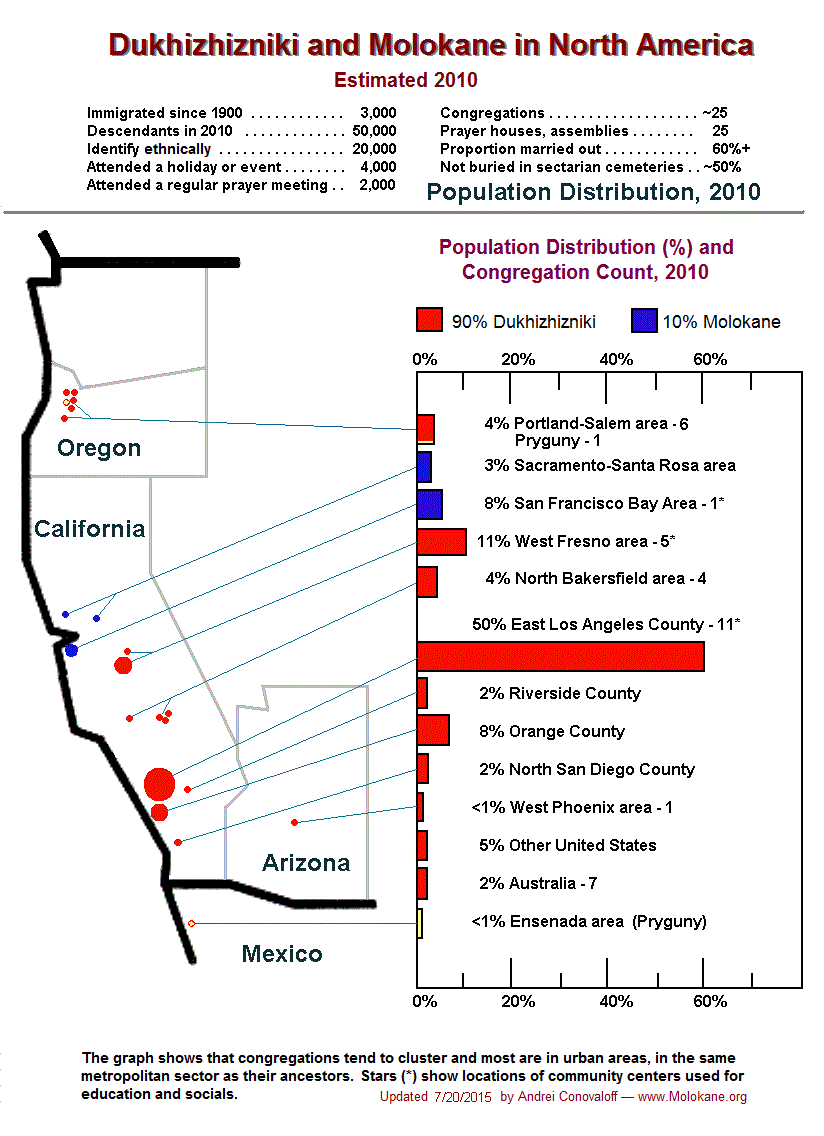
As Zheltov probes such questions as how to live the true "life of light," gain salvation, or understand the significance of Christ, he reveals an intense faith that is imbued with both rationalism and mystical tendencies. His searching study of the Scriptures testifies to the Molokans' acknowedgement of the Bible as a source of knowledge of the truth. The Molokans have much in common with the Doukhobors and other Russian sectarians who originated some three hundred years ago when a group of peasants broke with the Russian Orthodox Church. Persecuted for their pacifism and other beliefs, approximately 5,000 [actually about 2500, mostly Pryguny] [Many Spiritual Christians, including] Molokans chose to follow the Doukhobor example and leave Russia. In 1905-07, they emigrated to the United States, settling primarily [first] in Los Angeles[.] As Ethel Dunn notes in her preface, many American Molokans cannot read Russian; for those among them who wish to explore their Molokan heritage the translated volume is of undoubted use. The translator John Woodsworth also notes the interest that the volume will hold for students of the "religious, philosophical, or literary history of Russia" who are not familiar with Russian. The original text is characterized by many highly complex passages, however, and although the translator is to be commended on the whole for his rendering of them, there will be numerous instances when only by referring back to the original Russian will the reader be confident of grasping the writer's intent. This volume is another welcome example of the scholarly cooperation that the Canadian Slavic Research Group has developed in recent years with various Russian institutions, and the American publisher, the Highgate Road Social Science Research Station, deserves recognition for making it available in translation. [The Station closed about 2000.] |
Back to 51 Tolstoy / Molokan Letters
Back to Molokan NEWS
Back to Spiritual Christians Around the World