| Деловой
Экспресс Экономический еженедельник Армении 28 апреля — 4 мая 2005 №15 (623) |
[NOTE: Translation is
incomplete and in-progress.] Business Express Economic weekly journal of Armenia April 28 - May 4, 2005 — No. 15 (623) [Russian source.] |
| Регионы Армения — наша родина |
Regions Armenia is our motherland (native land) |
Так считают молокане Лорийской области |
What Spiritual Christians Molokans in Lori Region [Armenia] Think |
| На севере Армении, в
Лорийской области, вдоль магистрали, ведущей от
областного центра Ванадзора к Дилижану, на расстоянии
нескольких километров расположены два русских села -
Фиолетово и Лермонтово. Основанные в 1820 году
несколькими русскими семьями, сосланными сюда из
российского города Тамбова за религиозные убеждения, эти
села ныне стали второй родиной для русских молокан. |
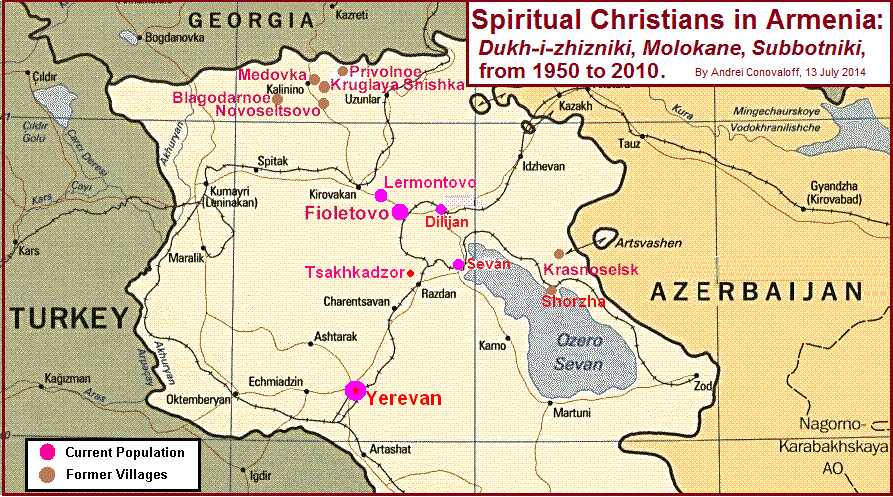
In the north of Armenia, in Lori District, along
a highway running from the regional center Vanadzor to
Dilizhan, in a distance of several kilometers [from each
other] are located two Russian villages, Fioletovo
and Lermontovo. Founded in 1820 by several Russian
families banished to here from the Russian city of
Tambov for religious beliefs, these villages nowadays
became the second mother land for the Russian Spiritual Christians
Molokans. |
 |
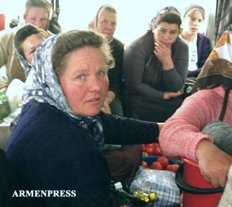 L to R: The 3rd woman in the back row (hand on chin) is Maria Morozova. Her daughter (right) Ania married Vladimir Ivanovich Kosminin, both moved to Adelaide, Australia. If you can identify anyone in these photos, please e-mail their names in. |
| "Мы
не приняли их нечистые обряды, заветы церкви, поэтому нас
и выслали, — так представляет историю переселения в
Армению 95-летний житель Фиолетово Иван Николаич. Само
название "молокане" происходит от евангелического "молока
духовного" и обычая в дни поста пить молоко. Молокане
иначе трактуют Библию, христианское вероучение, отвергают
обряды Православной церкви, церковную иерархию,
монашество, не признают поклонения иконам и кресту. Они
считают, что целью верующего является духовное
возрождение. В Армении есть общины молокан-"прыгунов",
"постоянных", "прыгунов-максималистов" и "субботников",
причем община "прыгунов" образовалась уже в Армении,
точнее, в 50-е годы 19 века в Эриванской губернии. |
"We did not accept their
impure [nechistye]
ceremonies and church teachings, therefore our history of
resettlement was that we were sent for some 95-years to
live in Armenia by Ivan Nikolaich Fioletovo. The name
"Molokans" originates from evangelic "milk spiritual" due
to their custom on fast days to drink milk. Molokans
interpret the Bible differently regarding Christian dogma.
They reject the ceremonies of the Orthodox church, the
Church hierarchy, monasteries, and they do not recognize
icons or the cross during worship. They consider that the
purpose of the believer is spiritual revival. In Armenia
there are [several] communities of Spiritual Christians Molokans —
"Pryguny", Molokane
"Constants",
"Jumper-extremists"
[prygunov-maksimalistov — here the author refers
to "Dukh-i-zhizniki"]
and "Subbotniki".
The
community of "Pryguny"
was actually formed in Ukraine then moved to Armenia, during the
1850s in Erevan province. [At that time, most of what is now Armenia was
named "Erevan province" (or state)" of Russia. After
1928, these Pryguny
in Armenia were transformed into Dukh-i-zhizniki
upon getting the ritual book: Kniga sol'ntsa, dukh i zhizn' mailed
to them by Maksimisty-Chuloshniki
from Los Angeles, California.] |
| Фиолетово (бывшее
Никитино) В этом селе сегодня имеется 585 хозяйств, часть местных жителей принадлежит к общине "максималистов", другая часть — к "постоянным" и "прыгунам". Причем представители разных общин посещают разные молельные дома. Здесь проживает лишь несколько армянских семей, и, в отличие от армянских сел, нет процесса миграции. В трудные годы после провозглашения независимости Армении село оставили лишь немногие, причем фиолетовцы, отправлявшиеся в Россию на сезонные заработки, как правило, возвращались в родное село. Как они говорят, "ведь Армения - наша родина". |
Fioletovo (formerly
Nikitino) In this village today there are 585 farms. Part of the local residents belong to the community of "Extremists" [Maksimisty], other part to Molokane "Constants", and Dukh-i-zhizniki "Pryguny". And representatives of the different Spiritual Christian communities attend different prayer houses. Some of the Armenian families, and, as against the Armenian villages here live, there is no process of migration. In difficult years after declaration of independence of Armenia the village was left only by the few, and Fioletov residents, going to Russia for seasonal work, as a rule, came back to their native village. As they say, "in fact Armenia is our mother land". [NOTE: Translation is incomplete and in-progress.] |
| Местные
крестьяне
очень добросовестны и трудолюбивы. Не случайно основными
категориями в их религиозных убеждениях являются
нравственное совершенствование, трудолюбие и взаимопомощь.
Они избегают различных увеселений, воздерживаются от
сквернословия, курения и пьянства. После землетрясения
1988 г. они даже отказались от гуманитарной помощи,
объясняя это так: "Пусть Господь дарует нам здоровье, а
хлеб насущный мы добудем сами". |
The local peasants are very
diligent and hardworking. It's no chance that the basic
categories in their religious beliefs are moral
perfection, diligence and mutual aid. They avoid various
entertainment, abstain from foul language, smoking and
drunkenness. After the earthquake of 1988 they even
refused humanitarian aid by explaining: "Let the Lord
grant us health, and we will make our own daily bread". |
| Население
Фиолетово
в основном занимается сельским хозяйством: пасет скот,
выращивает капусту и морковь, которые затем продают в
Ванадзоре. А седьмой день недели молокане отдыхают.
Ежедневно из двух молоканских сел в областной центр
перевозится для продажи около 5 тонн молока. Однако, по
словам сельского старосты Алексея Новикова, реализация
продукции остается проблемой для населения этих мест.
Плоды своего труда фиолетовцы доставляют в Ванадзор
автобусом своего односельчанина Моисея. Утром автобус
отправляется в Ванадзор, а к двум часам дня возвращается в
село. В любом районе Ванадзора можно встретить молокан с
молочными бидонами. Есть у них и постоянные клиенты,
которым они доставляют свою продукцию на дом. |
The population in Fioletovo
basically is engaged in agriculture: cattle grazing,
raising cabbage and carrots which they sell in Vanadzor.
And on the seventh day of the week Spiritual Christians Molokans
rest. About 5 tons of milk daily is transported for sale
from these two Molokan villages in the regional center.
However, according to the Rural Head Alexey Novikov,
realization of production remains a problem for the
population of these places. Fruits of the work Fioletov
deliver in Vanadzor by bus of fellow villager Moisei. In
the morning the bus is sent to Vanadzor, and to two one
o'clock in the afternoon comes back in village. In any
area Vanadzor it is possible to meet a Spiritual Christian Molokan
with dairy cans. Is at them and constant clients to whom
they deliver production to the house. |
| Молокане
свято
чтут традиции предков и следуют своим религиозным
правилам. "Между нашей и армянской религией есть
определенное сходство, — говорят они. — То же Евангелие,
та же Библия". Молокане отмечают и Святое Рождество, и
Пасху, и день поминовения усопших. В церковь они не ходят,
а молельные дома ничем не отличаются от обычных. Каждое
воскресенье молокане здесь читают Евангелие, молятся,
поют. "Максималисты" считаются нетерпимыми к компромиссам. Для вероотступников предусмотрены строгие наказания. "Прыгуны" верят в наступление "страшного суда", конец света и тысячелетнее владычество Бога на земле. Их молитвы сопровождаются потрясениями и прыжками. |
Molokane piously honor their
ancestral traditions and also follow the religious
rules. "Between ours and the Armenian religion there is a
certain similarity. They speak about the same Gospel, the
same Bible". Molokane observe
Sacred Christmas, and Easter, and memorial day for the
deceased. They do not attend a Church, rather their prayer
houses are very plain buildings. [In Russia tserkov' (church) implies an
ornate Orthodox
Church
building.] Every Sunday Molokane here read
the Gospel, pray, and sing. Maksimisty "Extremists" are considered intolerant of compromises. For apostates strict punishments are stipulated. Dukh-i-zhizniki "Jumpers" believe in approach of a "terrible judgment", a doomsday and the 1000-year reign of the God on earth [millennialism]. Their prayers are accompanied by shaking and jumping. |
| Каждое
из направлений этого вероучения имеет своего
предводителя-просветителя. Обязанности духовного пастыря
передаются по наследству, либо община сама избирает нового
духовного лидера. Безотносительно к разным направлениям
имеются обычаи, присущие всем молоканам. Как уже было
сказано, они не пьют, не курят, не сквернословят, не
блудят, не смотрят телевизор. Трудно вспомнить случай,
когда кто-нибудь из молокан обвинялся в каком-либо
преступлении. |
Each of the factions of
this dogma has a leader-educator. Duties of the spiritual
Pastor (presbyter)
are handed down [in the family], or the community itself
selects the new spiritual leader. Regardless of the
different factions there are customs inherent among all Spiritual Christians
Molokans.
As it has already been told, they do not drink, do not
smoke, do not talk smut, do not fornicate, do not watch
TV. It is difficult to recollect a case when somebody from
the Spiritual
Christians Molokans was accused of any crime. |
| Есть,
конечно,
у молокан и проблемы. К примеру, селяне недовольны работой
местной почты. Говорят, что плохо работают телефоны, даже
в Ванадзор невозможно дозвониться. В шутку замечают, что
хорошо телефоны начинают работать только накануне выборов.
Но села находятся в зоне досягаемости сотовой связи.
Вскоре в каждом из молоканских сел будет установлено также
по одному картофону. |
Certainly Spiritual Christians
Molokans
have problems. For example, the villagers are dissatisfied
with the local mail delivery. The say that the phones work
poorly, and in Vanadzor it is impossible to phone. Its a
joke that the phones start to work well only just before
elections. But villages are in the zone of reach of
cellular communication. Soon in each of the Spiritual Christian
Molokan
villages a cellular pay phone will be installed. |
| В
единственной школе Фиолетово учатся 228 детей. Учителя в
основном армяне, причем не местные. Многих здесь волнует
вопрос дальнейшего образования их детей. В Армении
молокане высшего образования не получают. После окончания
школы молодежь занимается домашним хозяйством,
сельскохозяйственными работами. Когда губернатор Лорийской
области Генрих Кочинян, встретившись с духовными пастырями
молоканских общин, предлагал им предоставить целевые места
в Ванадзорском государственном педагогическом институте,
желающих учиться так и не нашлось. |
At unique school Fioletovo
228 children study. The teachers are mostly Armenians, but
not local. Many are excited here with a question of the
further formation of their children. In Armenia v don't get
higher education. After leaving school the youth is
engaged in housekeeping, or field-agricultural work. When
the governor of the Lori Region, Henry Kochinian, met with
spiritual pastors of the Spiritual Christian Molokan
congregations, he suggested to them to give target places
in Vanadzor the state pedagogical institute, wishing to
study and was not found. |
| В
годы советской власти, когда в селе действовал филиал
Ванадзорской швейной фабрики, не было безработицы. Фабрика
давно не работает, а часть сельской молодежи лишь временно
была трудоустроена на Ванадзорском химкомбинате. И теперь
селяне связывают большие надежды с возобновлением полного
цикла работы этого химкомбината. |
Within the Soviet authority
when in village branch Vanadzor of a garment factory
operated, there was no unemployment. The factory for a
long time does not work, and the part of rural youth only
temporarily has been employed in Vanadzor's chemical
factory. And now peasants connect the big hopes with
renewal of a full cycle of work in this chemical factory. |
| Браки
между
представителями разных общин молокан не запрещены, но
встречаются не часто. Браки с "чужаками", в том числе и с
армянами, весьма редки. Женя Телегина - по национальности
армянка, так сказать, "меньшинство в меньшинстве". Ее муж
молоканин взял ее в жены с условием, что она примет их
веру ("прыгуны"). |
Marriages between members
of different Spiritual
Christian Molokan cogregations are not
forbidden, but don't happen often. Marriages with
"strangers" [outsiders] including with Armenians, are
rather rare. Zhenia Telegin, ethnically an Armenian, is as
they say "a minority in a minority". Her Dukh-i-zhiznik Molokan
husband took her as his wife with the condition that she
will accept his faith (v "Jumper"). |
| Молокане
-
добропорядочные граждане Армении, вовремя и полностью
платят налоги. Тем не менее, общинных средств не хватает
на ремонт здания школы, сельской дороги, системы
водоснабжения. В селе, конечно, есть клуб - остался в
наследство от советских времен. Однако сейчас это
полуразрушенное здание по назначению не используется. |
Spiritual Christians Molokans
are respectable citizens of Armenia. They pay all taxes on
time. Nevertheless, the community does not have
sufficient means to repair a school building, rural road,
or water supply system . In village, certainly, there is a
club - has remained in the inheritance from Soviet times.
However now this dilapidated building is not used for
anything. |
| Лермонтово
(бывшее Воскресенко) Село имеет около тысячи жителей, 130 из них — армяне, 50 — курды, остальные - молокане. Здесь также живет работящий народ. Все 280 гектаров пахотных земель полностью обрабатываются. Уровень сбора налогов самую малость уступает соседнему Фиолетово. Причина, как в шутку замечает сельский староста Эдик Чахалян, в том, что здесь больше армян. Община имеет 1000 голов крупного рогатого скота. Основным рынком сбыта для молочной и другой продукции является также Ванадзор. |
Lermontovo
(formerly Voskresenko) The village has about thousand inhabitants, 130 of them Armenians, 50 Kurds, the rest are Spiritual Christians Molokans [about 85%]. Here too there lives hard-working people. All of 280 hectares of arable lands are completely processed. The level of taxation most a little concedes next Fioletovo. The reason as rural head Edik Chahalian for fun notices, that here is more than Armenians. The community has 1000 head of large horned livestock. The basic commodity market for dairy and other production is also Vanadzor. |
| Оба
села недавно газифицированы, чего не было даже в советские
времена. Число потребителей газа постоянно растет. А до
этого некоторые умельцы сами находили возможность получать
"голубое топливо". Фиолетовец Павел Задоркин с помощью
придуманного им самим приспособления получал газ... из
навоза. |
Recently natural gas
stations were installed in both villages, which didn't
happen even during Soviet times. The number of
consumers of gas constantly grows. Before that only a few
skillful people could get "blue fuel". Fioletovo
resident Paul Zadorkin with the help thought up by him
adaptations received gas... from manure. |
| Проблема
питьевой
воды в Лермонтово была решена в 2004 году с помощью
водовода, проведенного из соседнего Антарашена, говорит
ведущий специалист областной администрации Семен Ананян.
Недавно полностью заменена и устаревшая система
электроснабжения обоих сел. А школа и Дом культуры в
Лермонтово будут отремонтированы в рамках программы
развития области. |
The problem of potable
water in Lermontov was solved in 2004 with the help the
water-water, lead of next Antarashen, the leading expert
of regional administration Simeon Ananian speaks. Recently
the out-of-date system of electrosupply of both villages
is completely replaced also. And the school and the House
of Culture in Lermontovo will be repaired within the
framework of the program of development of area. |
| Хотя
религиозные убеждения не позволяют молоканам смотреть
телевизор, 22 октября 2004 года при посредничестве
президента Армении Роберта Кочаряна здесь был установлен
ретранслятор. И теперь лермонтовцы могут смотреть передачи
Первого канала Российского телевидения, однако пока не
спешат воспользоваться этой возможностью. В связи с этим
помощник губернатора Лорийской области Эдик Ованнисян
отмечает: "При оказании какого-либо содействия молоканам,
при реализации любых программ обязательно надо учитывать
их религиозные убеждения, чтобы помощь не обратилась во
зло". |
Though religious beliefs do
not allow Spiritual
Christians Molokans to watch TV, on October,
22, 2004 at intermediary of the president of Armenia
Robert Kocharian the retransmitter here has been
established. And now Lermontovo transfers of the First
channel of the Russian TV can look, however do not hasten
to take advantage of this opportunity yet. In this
connection the assistant to governor Lori Region Edik
Ovannisian marks: "At rendering any assistance Spiritual Christians
Molokans,
at realization of any programs it is necessary to take
into account their religious beliefs that the help has not
addressed in evil". [NOTE: Translation is incomplete and in-progress.] |
| Система
семейных
и других пособий, действующая на территории всей
республики, местными жителями не принимается. Молокане
предпочитают собственными силами решать свои проблемы, не
привлекать к себе внимания. Ни по какому вопросу они не
обращаются в органы местного самоуправления, если только
это не касается закона. А взамен они рассчитывают на
невмешательство в их внутриобщинную жизнь. Они
отказываются и от видеосъемок и неохотно позволяют себя
фотографировать. |
The system of family and
other grants working in territory of all republic, is not
accepted by local residents. Molokans prefer to solve own
forces the problems, to not involve in itself attention.
On any question they do not address in institutions of
local government if only it does not concern the law. And
in exchange they count on non-interference to their
intracommunal life. They refuse and video shootings and
reluctantly allow to themselves to be photographed. [Fear of photographers is
by Dukh-i-zhizniki and Maksimisty. The Molokane have
allowed film crews to document their service and
community.] |
| Молокане,
проживающие
в Армении на протяжении уже двух веков, в своей
повседневной жизни сталкиваются с теми же проблемами, что
и армяне. Может показаться даже странным, что отличающиеся
остроумием армяне, любящие подшучивать над своими же
соотечественниками из других районов, не сочинили ни
одного анекдота о молоканах, которые мирно и сплоченно
живут бок о бок с ними, любят эту землю и считают ее своей
родиной. |
Spiritual Christians Molokans
have been living in Armenia already for two centuries, and
they face the same problems in the daily life as the
Armenians. Can seem even strange, that the Armenians
distinguished by wit, loving to play a trick on the
compatriots from other areas, but have not composed any
joke [anecdote] about Spiritual Christians Molokans
who peacefully and in unity live side-by-side with them,
love this country and consider it their home land. |
| Арменпресс | Armenpress |
|
|
|
|
Spiritual Christians in Armenia Spiritual Christians Around the World |
|