|
The Baja Beat
The Pryguny
Russians of Guadalupe
Valley
by Greg Niemann
 I
didn’t
plan on meeting Spiritual Christians from
Russia I
didn’t
plan on meeting Spiritual Christians from
Russia Russians
that trip. It was the wineries of Baja
California that drew my wife and I to the
Guadalupe Valley. I’d written an article about
the wineries of Baja California and needed
photos to supplement the story.
Most of Baja’s
wineries, including Santo Tomas, L.A. Cetto,
Domencq, Mogor-Baden and Monte Xanic, are in
the fertile Guadalupe Valley some 20 miles or
so northeast of Ensenada on Highway 3. Rather
than backtrack from Ensenada we took the
graded road off the old (libre) Highway 1,
about 12 miles south of La Mision.
I’d driven the
road several times before and continually
delight in the trim ranches, fertile farms,
numerous orchards with straight rows of peach,
apricot and olive trees, the knurled stumps of
the vineyards and the bright multi-hued flower
fields along the way. While I’d heard of the Pryguny Russians
who had settled there, I was usually searching
for something else, like this trip’s wineries.
Other times it was the route of the gold
miners who went through here in the 1870s and
1880s, or the old mission (Baja’s last,
established in 1834).
In fact the
mission was referred to as the peninsula’s
most prosperous and powerful with over 400
Indians, 4,915 head of cattle and fertile
fields fed by an intricate irrigation system.
But it had the shortest life of all as in
1840, the leader of the Kumiai Indians Jatnil
didn’t like the forced conversion of his
people and led a successful revolt against the
mission, chasing the padres out of the valley.
It is said that Padre Felix Caballero fled
leaving most of the mission’s livestock.
Plentiful water in an attractive
valley
The Kumiai
people Indians
who had been in the area for thousands of
years found the plentiful water and the flora
and fauna dependent upon the water to their
liking. They called the place Oja Cunurr, or
Painted Caves, alluding to some crude rock art
found in nearby rock outcroppings. The
paintings have since been destroyed, but the
rich, fertile rolling hills dappled by
mountain oaks make the valley attractive to
all who came through it. 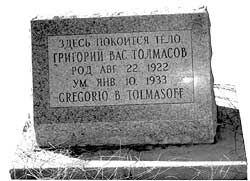
This time we too
fell under the valley’s spell and decided to
make it a leisurely day. That’s when we saw
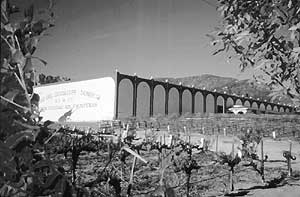
the sign “Museo Comunitario ‘Valle de
Guadalupe’ Tel: (615) 5-20-30” nailed to a
huge eucalyptus tree in front of a white block
house with a steep roof that looked
incongruous in the Baja sunshine.
We entered to
discover an Old World heritage proudly
displayed in a New World setting. We were
enthralled by the old photos and Russian
artifacts and enraptured by the charm of our
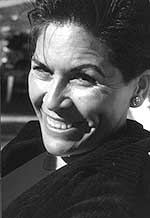
hostess Francisca Samarin, herself a
descendent of a colony of Pryguny Molokan
(milk-drinking) Russians who
settled here from
Russia beginning in 1905 a
long time ago.
The curious
settlement started a century ago in Kars,
Russia (now Turkey) where a religious group
which called themselves The Brotherhood of
Spiritual Christians Molokans
(milk drinkers) whose ancestors had split
from the official church of Russia at the
time, the Eastern or Greek Orthodox
Christians. The Pryguny
Molokans followed strictly what
they considered the laws of Moses and
abstained from pork, tobacco and alcohol. They
interpreted the term “spiritual milk” noted
in the Bible to mean they should receive
much of their nourishment from milk and
dairy products.
Pacifists in a country at war
It was not their diet
but their conviction as conscientious
objectors that got them into trouble with Czar
Nicholas II. The pacifist Pryguny
Molokans refused to serve
in the military and with a war going on, they
found it prudent to seek a mellower climate and lower rents and taxes.
So they temporarily moved to
California, most settling around Los Angeles.
This rural group, however, found a big city
environment a little difficult for raising
crops and had to look elsewhere.
Their prayers were
answered in 1905 as Mexican President Porfirio
Diaz agreed to sell the sect 13,000 acres of
fertile land in Baja California’s Guadalupe
Valley. The deal was
brokered by Donald Barker, a Los Angeles
attorney and investor with interests in
Mexico, who arranged for his loan to be paid
back to his flour mill in Ensenada with
wheat.
Other ranchers
had already arrived in the valley and the
fledgling viniculture of the area had already
begun, along with cattle ranching and other
farming.
The 105 families
of Russian settlers from Russia (about
500 total) laid out their town the way they
had at home, equal partitioned lots along a
broad tree-covered avenue. Their whitewashed
adobe and wood homes with steep-pitched wooden
(some thatched) roofs had front doors that
faced away from the street.
They set about
planting grains and vegetables, olives and
grapes and raised gaggles of geese and bees
for honey. Their homes had basements to store
their jams, preserves and honey. They baked an
excellent Russian wood-oven bread and
drank tea or “chai” made in the samovar. Their
main dish was borshch
Borscht, which they ate cooked
with wooden spoons.
The Pryguny
Molokans worked hard and
prayed hard. They dressed simply with women
covering their heads with homemade “kosinkas”
or shawls, and the bearded men wore
high-collared shirts called “rubajas” which
had drawstrings around the waist.
Citizens of Mexico
They became
splendid citizens of Mexico and while they
spoke Russian during meetings
in church and at home, were
ever loyal to their adopted country. It is
said that Russian-born Mary Rogoff , while she
had only a third grade education, delivered
over 1,000 babies to the women of the valley.
 In
1938
the popular Mexican President Cardenas
designated lands for the peasants of Mexico.
Guadalupe was engulfed by 3,000 Mexicans and
the town was renamed Francisco Zarco. Many Pryguny In
1938
the popular Mexican President Cardenas
designated lands for the peasants of Mexico.
Guadalupe was engulfed by 3,000 Mexicans and
the town was renamed Francisco Zarco. Many Pryguny Russians
left at that time. Others stayed and over time
have assimilated into the culture.
According to
Francisca Samarin, “Today there are only 20
pure Caucasians from
Russia Russians
left in the Guadalupe Valley, but…” she added
with a grin, “There are about 240 of us with
mixed blood.”
The museum
consists of a couple of rooms and while Senora
Samarin was showing us around, some light
haired, light-eyed children played at her
feet.
Around back of
the museum was a special room, the sauna. Like
the many others in the community, it was a
small room with heated stones in a platform in
one corner onto which they poured water
getting the stones red hot and the bodies to
perspire like they’d entered the gates of
hell.
Construction was
going on in one room. “This we hope to turn
into a restaurant,” she said. “We want to
serve traditional Russian-style
food like our ancestors used to make.’
That sounded good to
us and we plan to check it out next visit.
After we left we drove over to the Old Russian
cemetery, where headstones inscribed in
Cyrillic script attest to the legend of the Prygun
Russian
colony of milk drinkers that
found their peace so far away from home.
That the area is
surrounded by Mexico’s top wineries now is
further proof that Baja has something for
everyone. b
(c, a regular contributor to the San Clemente
Journal, is the author of “Baja Fever,” and
“Baja Legends,” from which this article is
excerpted. Both are available in bookstores
and on the Internet.)
|
|
