Baku
Molokan Cemetery
Completely Destroyed!
Roads and
houses built.
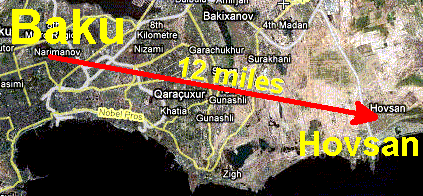
Casket parts moved 12 miles east.
Posted September 9, 2007
— Hundreds of Molokan graves are being destroyed to build
roads and houses on the 100+ year old Molokan cemetery in Baku, the
capital of the Azerbaijan Republic. Little warning was
given. 10-15 acres were
destroyed by the end of 2007. What can we
all do to help? Send money to the churches? Protest 6 ways? [Click on photos to
enlarge.] Updates:
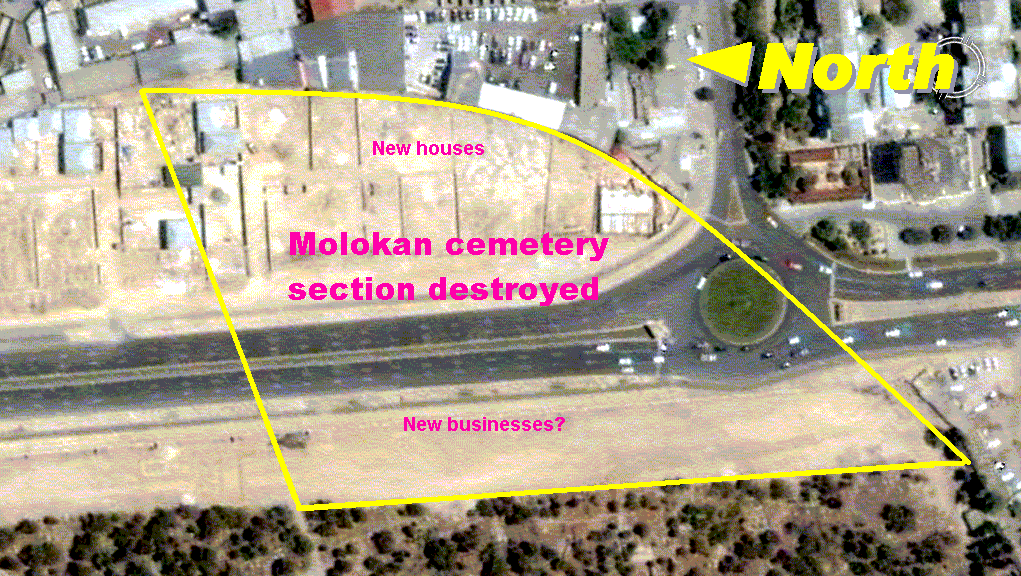
- Jun 18, 2009 — Aerial photo
shows complete destruction.
"Molokan Settlement" history added to text and maps.
- May 1, 2008 — Aerial photo of
2007 cemetery damage, one highway finished, houses
built, more to come ...
- Jan 1, 2008 — Cemetery will be moved using state funds
- Sep 20-25, 2007 — News in 2 languages:
- Sep 18, 2007 — Caucasus Conflict Portal
- Sep 14, 2007 — Photos of grave contents being moved.
- Sep 14, 2007 — Video on YouTube.com in 2 languages
- Sep 12, 2007 — Russian Embassy in Baku receives numerous complaints about Christian cemetery demolition
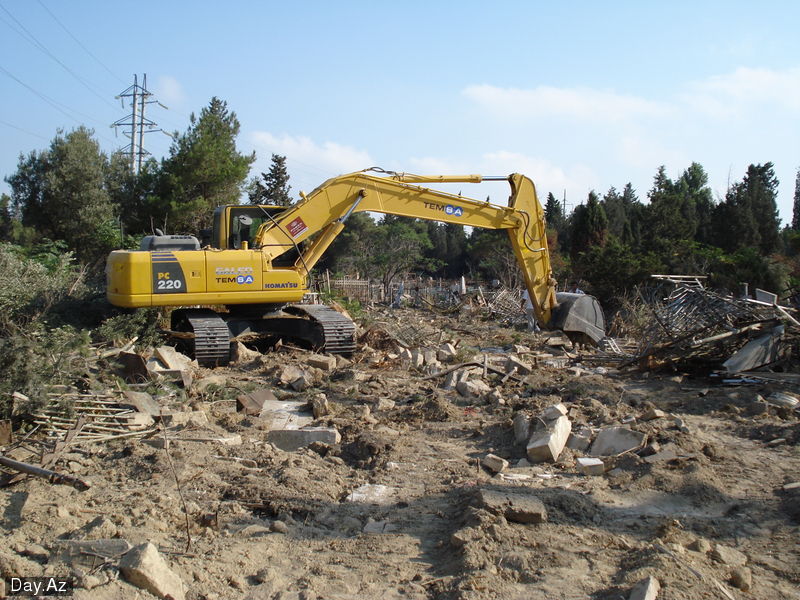
Destruction at the Nariman cemetery, also known as Montinskoe, Armenian, Christian, Russian, Veterans and Molokan cemetery, where Russians, soldiers, Jews, Tatars, Georgians and Armenians are buried since the founding of Baku. The entire cemetery is being relocated body by body 12 miles east to Goussan, Gousan, Govsan, Govsany, Gousany, Hoevsan, Hövsan, Hovsan
Spring work began again January 25, 2008 with low paid workers tossing exhumed bodies around if no relatives were watching. The city is out of cheap transport caskets. Families can buy them from vendors. On the other hand the Counsulate General of the Republic of Azerbaijan in Los Angeles says all new construction is on hold.
Workers and thieves were stealing jewelry, metal fence and granite.

September 4, 2007 — Katya Karagadayeva was the first to report the tragic news to Molokan.org:
"My mother, Antonina
Fedorovna Kudelina, is from a Molokan family. She grew up
in the 'Molokanka' district of Baku. Her parents (my
grandparents), grandparents, aunts and uncles are buried
in that cemetery. Today I spoke with my cousin, Roman
Kudelin, who flew urgently from Moscow to Baku to save our
family's graves. He was able to move three of five
coffins. The rest are left there and will be destroyed.
They could not move some of the headstones because they
were 'too heavy'. From what I was told, everything is done
by hand, without the use of tractors, or back hoes. If
Roman didn't get there on time, we wouldn't have been able
to save anything. Please,
let me know if you have any more questions. I really
appreciate you taking this interest in this matter. I
realize that a cemetery in a central part of a large city
is an inconvenience, I just hate the disrespectful way
Baku administration chose to go about getting rid of it.
Is there "
Sept 10, 2007 —
Katya updated her report:... He [Roman] saw graves as
new as a month old that got destroyed. ... People are
asking me where they can write to protest, if there's a
petition they can sign. Do you have any thoughts about
that?
Katya's relatives who conducted a funeral 2 weeks ago reported no harm to the Molokan section at that time. Last week, the new construction caught them off guard. She begs Molokans around the world to help move our graves to new locations. The city is helping somewhat by preparing new graves in several outlying cemeteries. One is in Gousan. See photos of Reburials below.
September 7, 2007 — the Counsulate General of the Republic of Azerbaijan in Los Angeles did not have any knowledge about destruction at the Molokan cemetery in Baku. One staff member, an attorney Consular in Legal Affairs named Elshan Baloghlanov, said he was scheduled to visit Baku on September 14 for a week. He will personally visit the cemetery and try to help. In the meantime he suggested that Molokans visit the Baku mayor with protests.
September 7, 2007 — By phone, Matrona Schetinkin, wife of the Senior Presbyter of the Union of Spiritual Christian Molokans (USCM), Timofei Vasiliech, said she had not heard any reports about the Baku Cemetery. Her family and congregation are from the Azerbaijan hills, and many have relatives in the city. The next day Matrona talked with a Molokan woman who just returned from Baku. Matrona cried as she reported that Molokan graves and headstones were dug up and moved out of the way of the road construction. She said Molokans in Baku knew about the first road, but the second was a surprise. Rumors are the city will build over the entire cemetery.
Sunday, September 9, 2007 — Announcements were made at a few Molokan churches, in Kochubeevskoe, Moscow, Los Angeles and Kerman; also the Cemetery Committee which represents 10 congregations near Los Angeles was notified. Baku Molokans have not yet reported an action plan or request for funds to help move hundreds of caskets and monuments.
Construction of one road ("Road 1", right map) along the west side of the cemetery was started in 2003. It was publicly announced in February 2003 against much protest. At that time only a 30 meters (less than 100 feet) along the west edge was to be taken for a road. The Administration of BakuPages.ru volunteered to help coordinate relocation of graves.
February 24, 2003 — PanARMENIAN.Net reported:
Baku
authorities
to demolish Armenian and Russian graves
Власти Баку намерены ликвидировать армянские и русские могилы
"On April 1 Baku authorities intend to begin demolishing Armenian and Russian graves situated in the segment of Narimanov cemetery, where a new highway will be laid. ... "their being abandoned for over 12 years" as a formal cause for destroying the graves... international organizations such as the International Committee of the Red Cross could contribute to the reburial of the Armenians and Russians in Armenia and Russia."
Власти Баку намерены ликвидировать армянские и русские могилы
"On April 1 Baku authorities intend to begin demolishing Armenian and Russian graves situated in the segment of Narimanov cemetery, where a new highway will be laid. ... "their being abandoned for over 12 years" as a formal cause for destroying the graves... international organizations such as the International Committee of the Red Cross could contribute to the reburial of the Armenians and Russians in Armenia and Russia."
March 17, 2003 — Caucasus Reporting Service reprints
War and Peace
in the Caucasus: 100 selected articles from IWPR’s
Caucasus Reporting Service, 2005. Pages 129-130.
Baku cemetery controversy: Plans to build road through Baku cemetery may lead to destruction of thousands of old graves, including Armenian ones.
Война и мир на Кавказе: 100 избранных статей Кавказского информационного еженедельника, 2005. Стр, 137-139
Спор вокруг христианского кладбища в Баку.
Baku cemetery controversy: Plans to build road through Baku cemetery may lead to destruction of thousands of old graves, including Armenian ones.
Война и мир на Кавказе: 100 избранных статей Кавказского информационного еженедельника, 2005. Стр, 137-139
Спор вокруг христианского кладбища в Баку.
April 24, 2003 — Felist.com reported:
Editor-in-Chief
of
TURAN news agency condemns destruction of Christian
cemetery in Baku
"A public closing its eyes on construction of roads via a cemetery and on the theft of marble from tombs for further sale, should not speak of the God or Allah," said Editor-in-Chief of the Azeri TURAN news agency Shain Hajiyev in his interview to the Baku "Echo" newspaper. ... weeks-long scandal around the pulling down of the cemetery.
"A public closing its eyes on construction of roads via a cemetery and on the theft of marble from tombs for further sale, should not speak of the God or Allah," said Editor-in-Chief of the Azeri TURAN news agency Shain Hajiyev in his interview to the Baku "Echo" newspaper. ... weeks-long scandal around the pulling down of the cemetery.
Several stories appeared in 2006, for and against the project. A posting on HayLife.ru states that the Armenian non-profit «Азат Гайк» [Azat Gait] will help.
- Принято
решение о переносе христианского кладбища в столице
Азербайджана за государственный счет — 365.AZ, Jan
19, 2006
Machine translated: It was decided to move the Christian cemetery in the capital of Azerbaijan at state expense
- "This is an Armenian cemetery, and it needs to be destroyed." — RealAzer.com, Jan 17, 2006
- На
месте
христианского
кладбища в Баку строят... коттеджи — Russkaia Liniia [Russian
Line], Feb 20, 2006
Machine translated: Houses are being built on a Christian cemetery in Baku - Another
act
of vandalism carried out by Azeris — Public Radio of Armenia,
Feb 20, 2006
- Mayor
of Baku destroys old Christian (Molokan) cemetery
— REGNUM News, Feb 20, 2006
Мэр Баку уничтожает старое христианское кладбище
- По
ком звонит колокол... — Forum.HayLife.ru [Armenian Life forum],
Mar 14, 2006 (Translated: For
whom
the bell tolls...)
- Plan of construction of road crossing Armenian cemetery in Azerbaijan existed since Soviet times — Arminfo, Apr 18, 2006
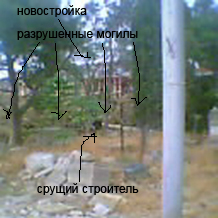
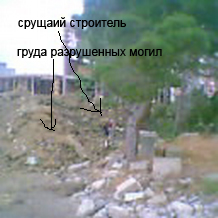
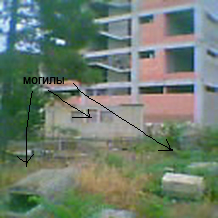
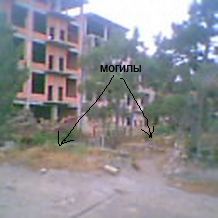
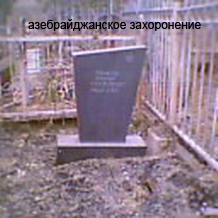
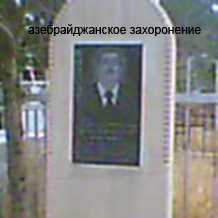
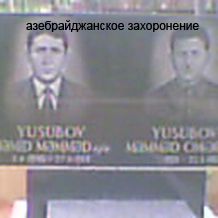
July 18, 2007 — The Day.AZ/forum showed 12 photos taken with a cell phone were posted showing buildings constructed in the cemetery, damage to graves, and that Azeris are also buried there.
She reports: "I happened to photograph a trowel and shovel worker defecating directly on a pile of rubble. When I approached him he urgently began to wipe his ass and disappeared. I was only able to to photograph him from a distance." Then said they forbid her to take more photos.
She says the families were scammed for money. "When relatives of the deceased arrived the owner of the cemetery began to demand 300 manat [$352], but after a half-hour skirmish and calling somewhere he agreed on 60 manat [$70] for the workers."
You need to join the forum and search to see the posting. [Click on photos to enlarge.]
- Снос монтинского кладбища, ваше отношение к этому вопросу?
- Translated: Destruction of the Montin Cemetery, your reaction to this question?
 |
 |
 |
 |
 |
 |
 |
 |
 |
 |
 |
 |
A new highway ("Road 2", map above right) through the Molokan section apparently was first announced in a short story by Day.AZ news on August 31, 2007:
- Завтра начнутся перезахоронения на Наримановском кладбище
- Translated: Tomorrow reburials will begin at Narimanov cemetery
History
This cemetery, one of 90 in the Baku area, is the largest near the city center. It's very prime real estate located near Metro (subway) and train stations, 2 major stadiums, a hospital, university, hotels, and blocking major streets.
It's officially named the Montin cemetery, and/or the Narimanov cemetery. Montin and Narimanov are adjacent regions of Baku. Few Muslims are buried there, and the Azeri nationalists hate Armenians and Russians so the graves have little value to half of the Azeris. The other half are upset at the city mayor.
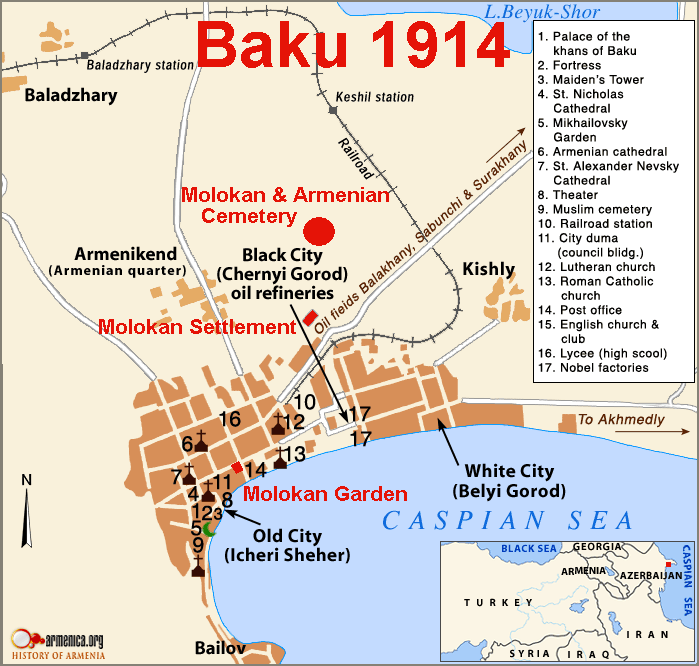 The Molokans may
have founded this cemetery over 100 years ago, before 1890,
and call it the Molokan cemetery. [Click on "Baku 1914" map]
The Molokans may
have founded this cemetery over 100 years ago, before 1890,
and call it the Molokan cemetery. [Click on "Baku 1914" map] Many Molokans first settled in Baku on a 2 acre lot on the east side where they kept horses and maintained a large market. The city took the Molokan settlement to build a park, since popularly called Molokan Garden. In exchange, Molokans were given about 10 acres just north of Baku along a major highway, near the train station and closer to the cemetery. There they built a new "Molokan Settlement", still called Molokan Slobodka. in Zavokzalnaia (near the train station) district.
Jews and Armenians were also given settlement areas outside Baku. Jews built their own cemeteries. Armenians added an Armenian section to the Molokan cemetery. During World War II a veteran section was added for Russian Orthodox soldiers. Azeri's often call it all the "Russian" or "Christian" cemetery, though some Muslims are also buried there. This Montin cemetery is large, covering 80 hectares — 198 acres, or 0.31 square miles. It is about one mile long and half a mile wide. In and around Baku there are about 90 cemeteries.
The cemetery was way out in the country and did not expand rectangular, and became irregularly bound as the city grew around it. Major roads from Baku were blocked by the cemetery, and were being planned during Soviet times to go through the cemetery.
The Baku Molokans cemetery occupies 40 to 50 acres, more than 8 times the area of the Jumper Molokan Cemetery in Los Angeles on Slauson Ave, City of Commerce, California. Burial plots in the US are smaller than 50 square feet (5' x 10'), often 24 sq. ft. (3' x 8') side-by-side. Old Eastern European family grave plots are much larger, 100 to 200 sq. ft., often enclosed with fences including a built-in bench and table for visitors, and flowered landscaping.
September 8, 2007 — Day.AZ.ru gives a progress report with new dis- information:
- Продолжается перезахоронение на Наримановском кладбище
- Translated: Reburial Continues at the Narimanov cemetery
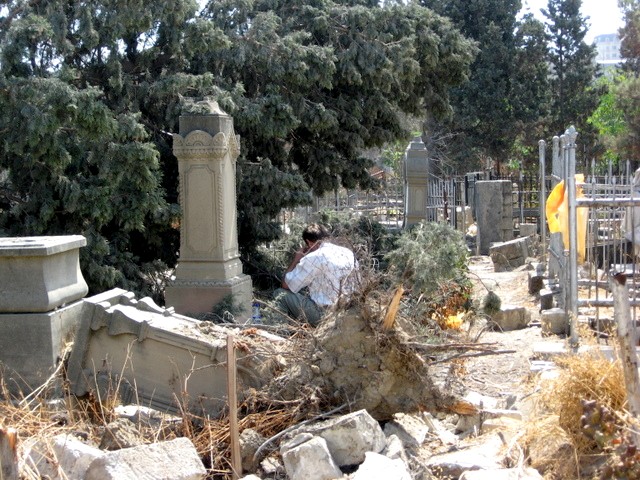
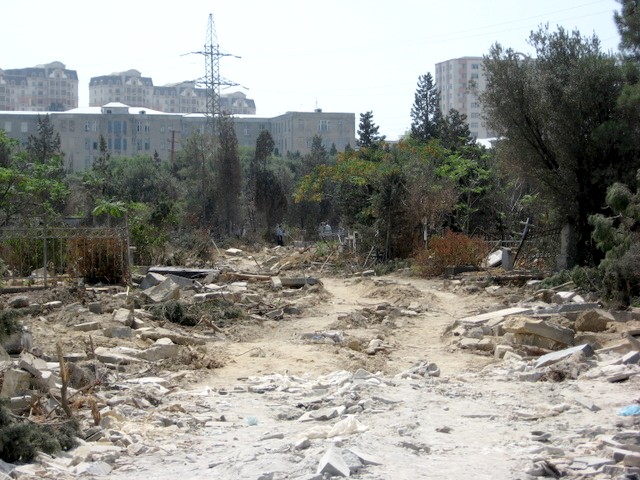
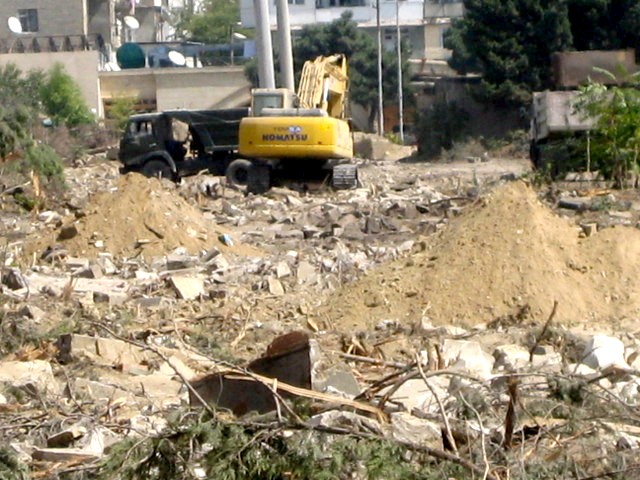
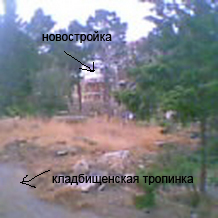
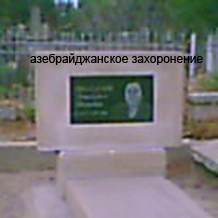
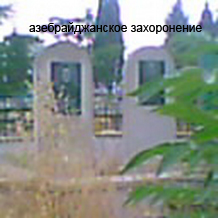
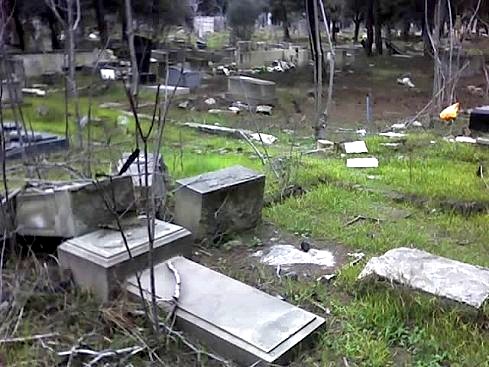
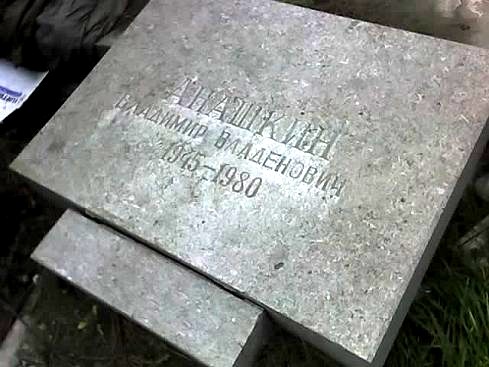
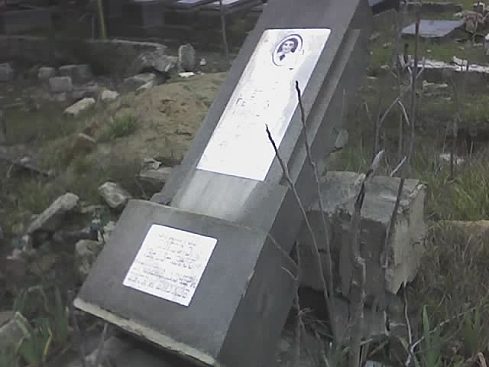
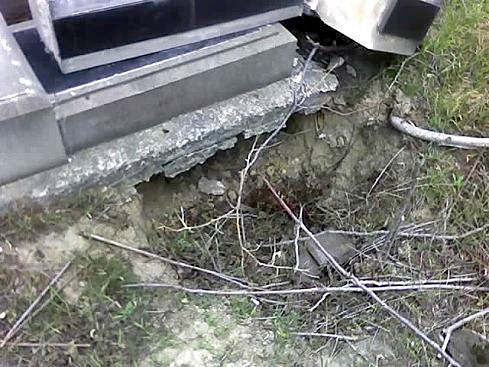
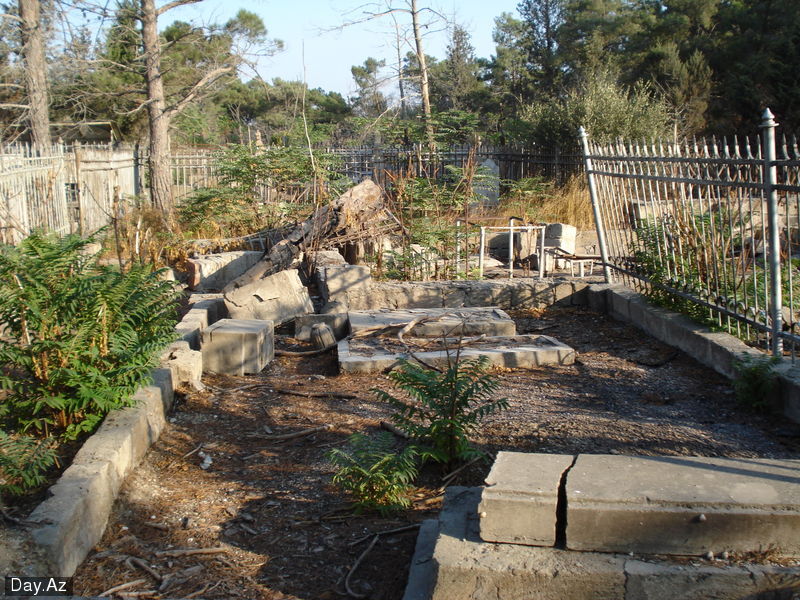
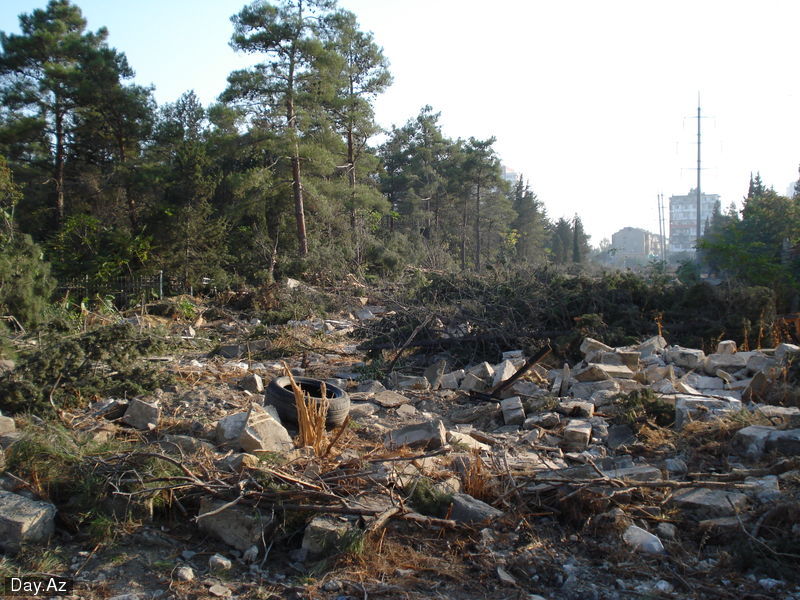
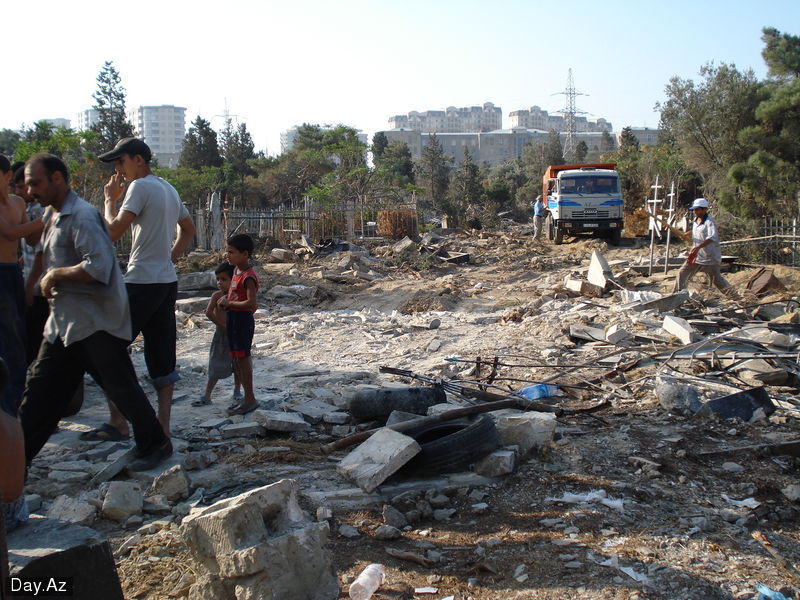
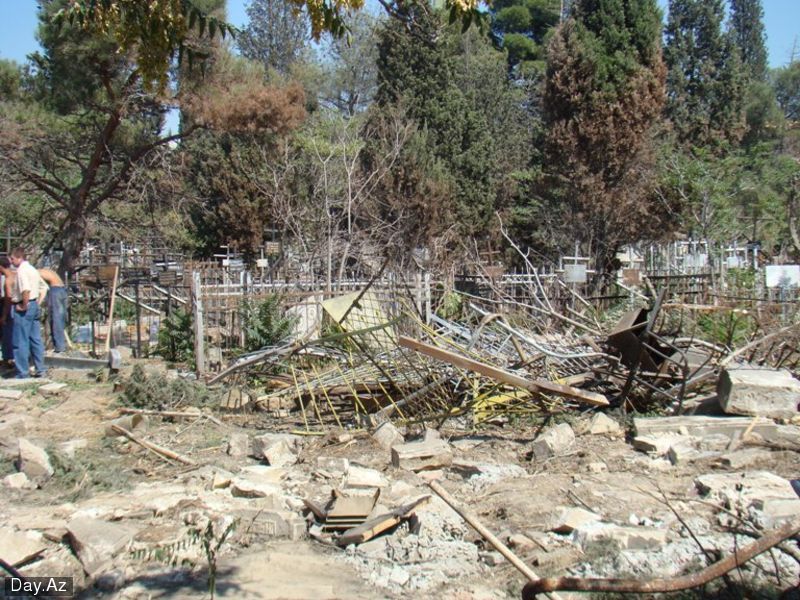
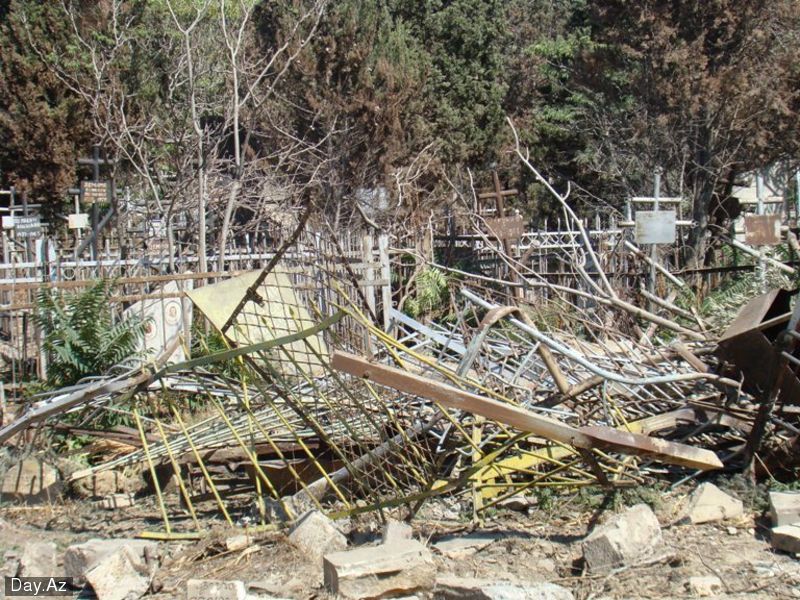
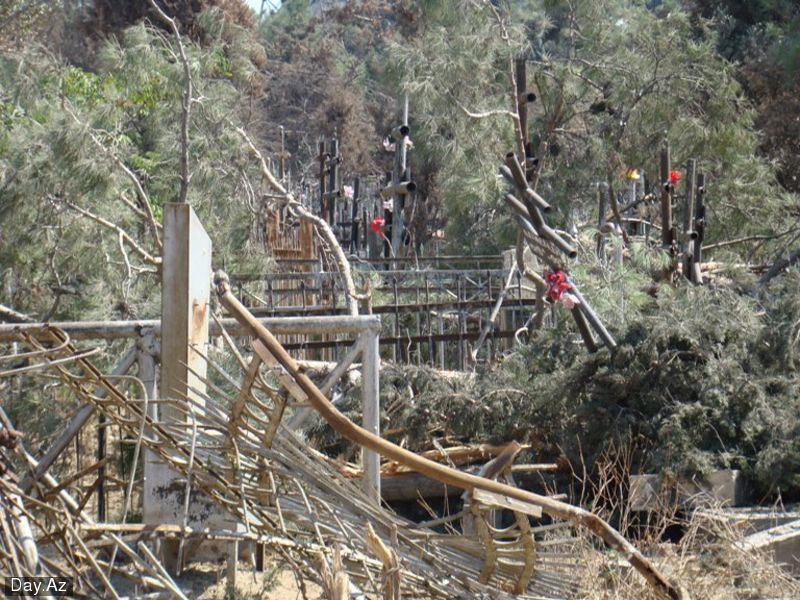
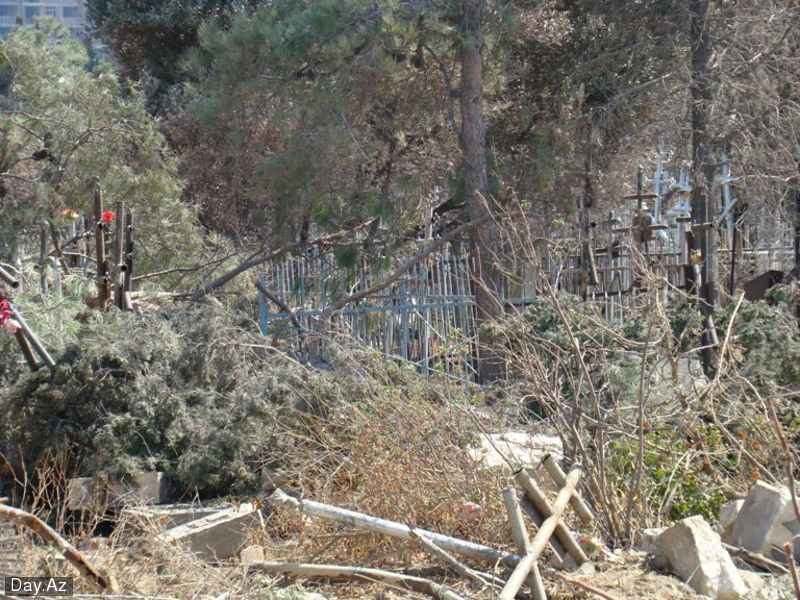
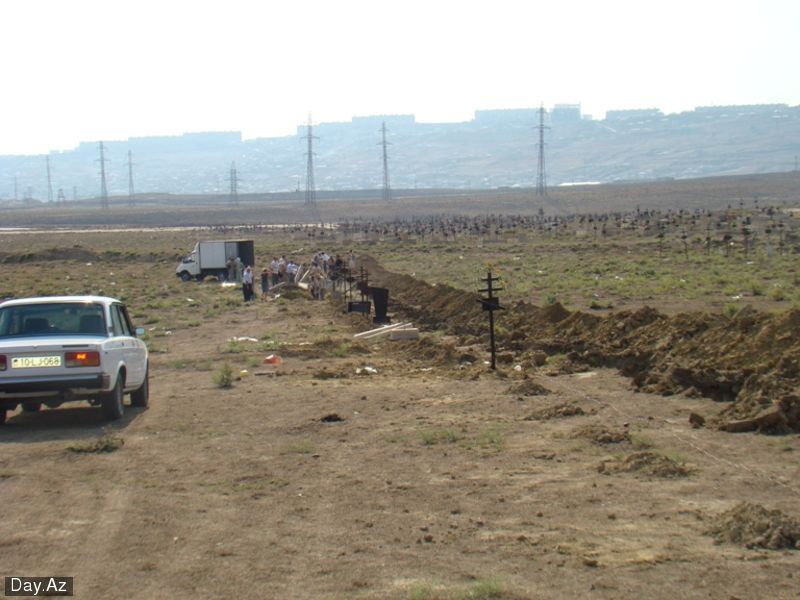
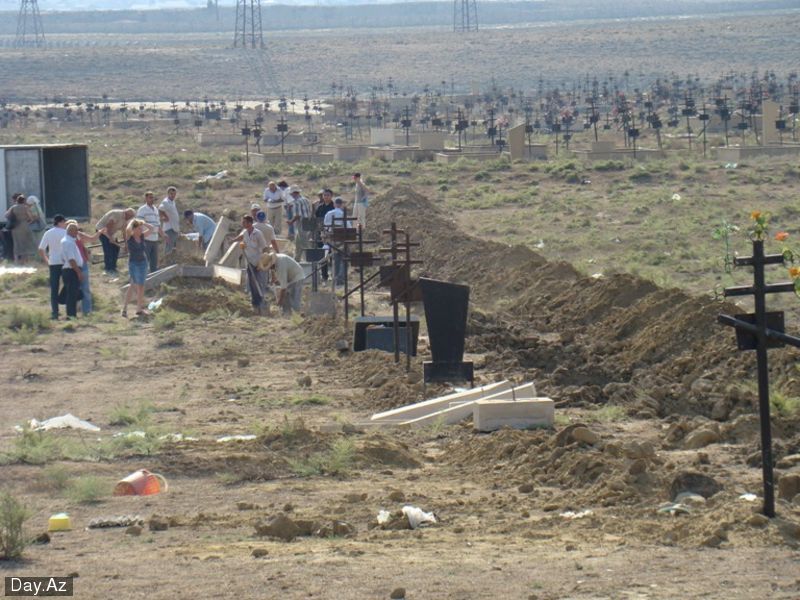
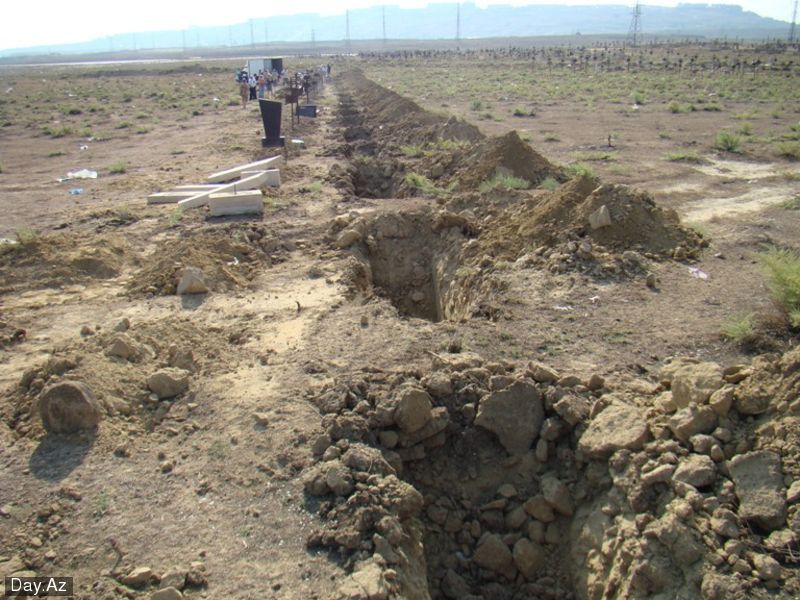
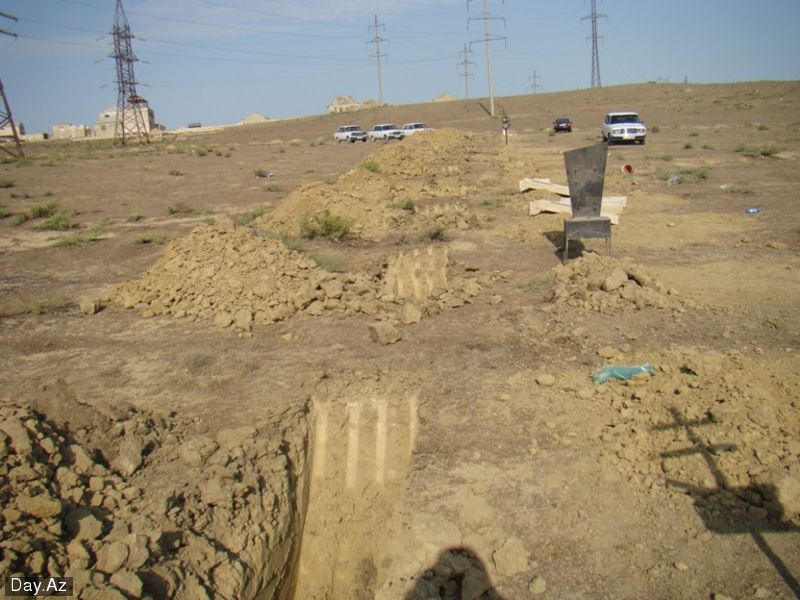
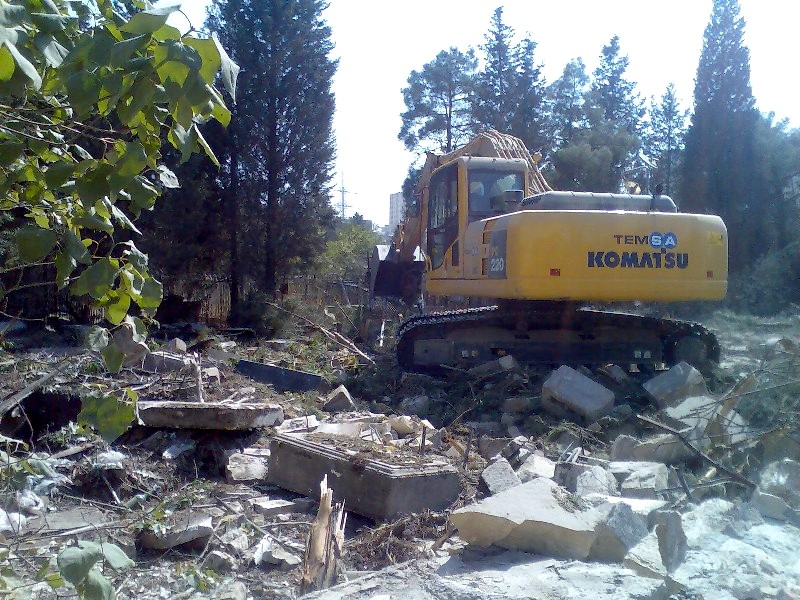
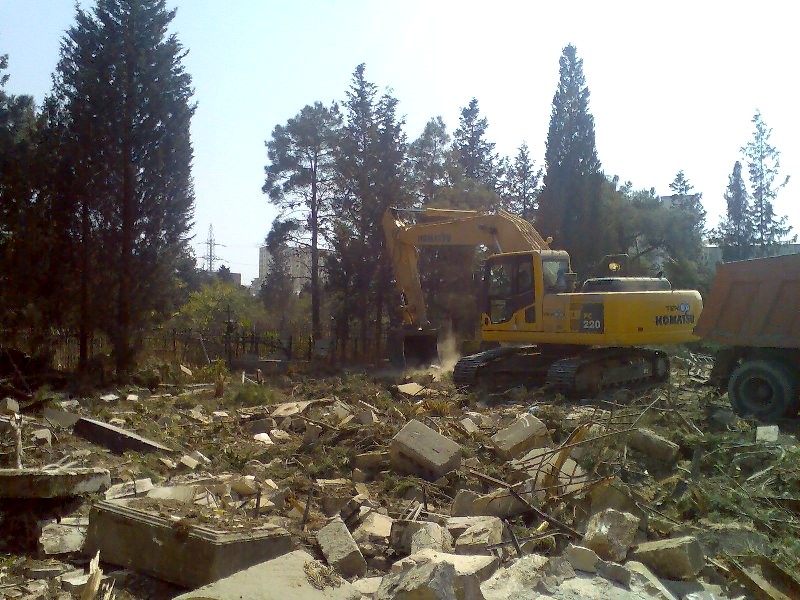
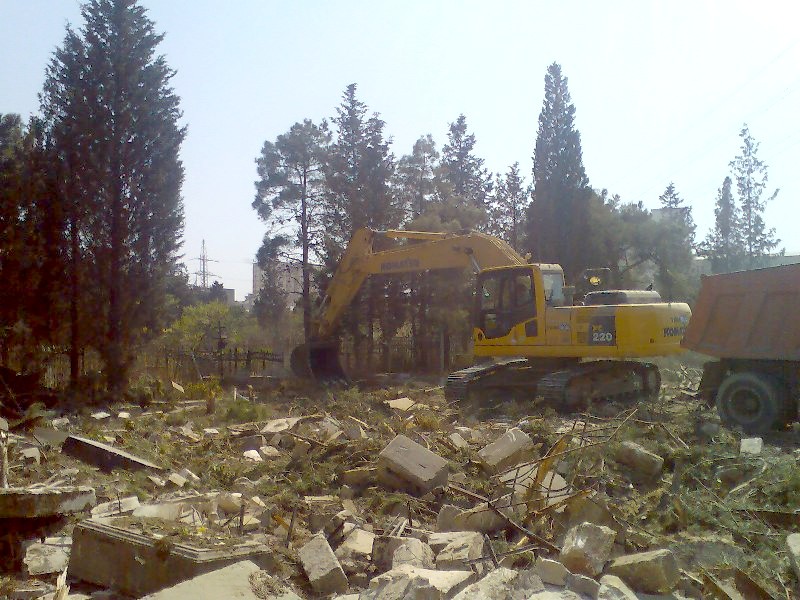
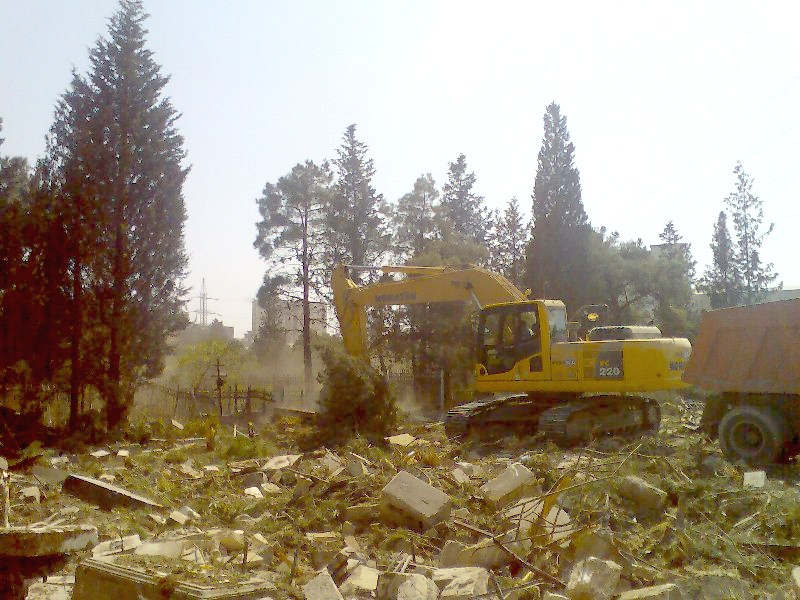
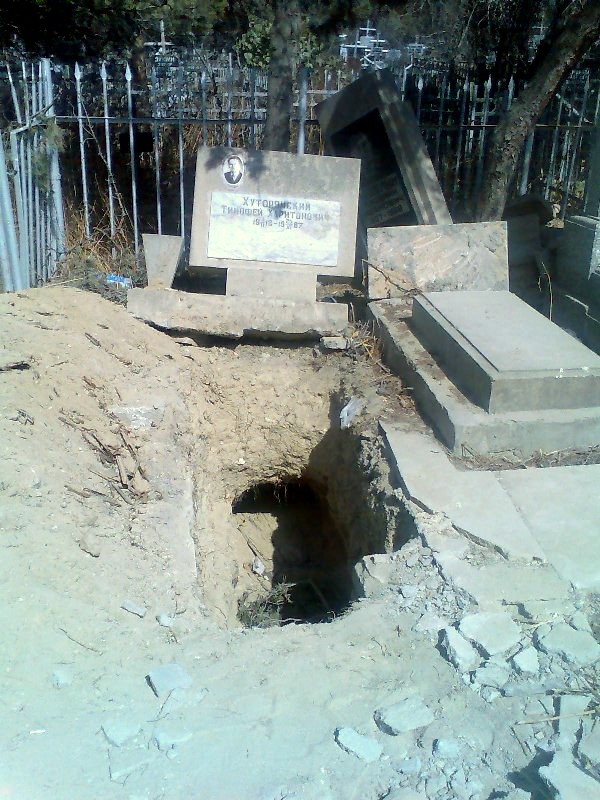
September 10, 2007 — Message #255 posted on the Day.AZ Forum by Buckingham shows 7 photos (right) of the Molokan section and gives his first-hand report about two families he met there:
[Translation] This afternoon
I decided to go to the Montins cemetery. I have to say
this — I saw a lot of horror in my life, but I never saw
such a nightmare [as this].
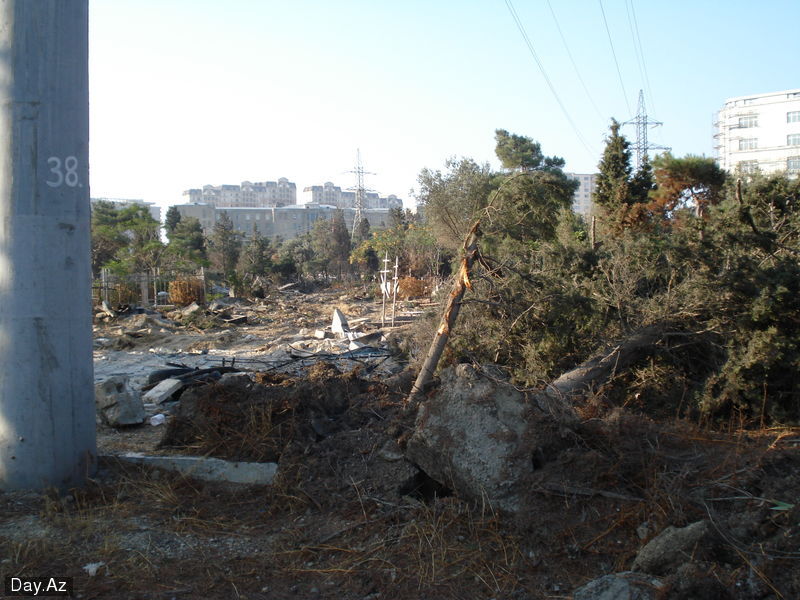
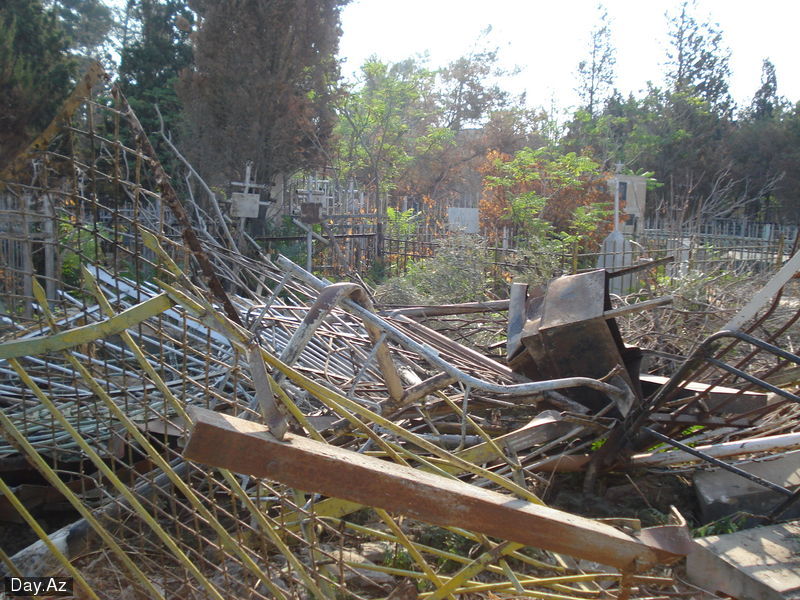
The cemetery is smashed up
in the center by a planned highway — a continuation of
Inglab street [now "Hasan Aliev" street, the west end of
"Road 2" through the Molokan section]. Graves are broken,
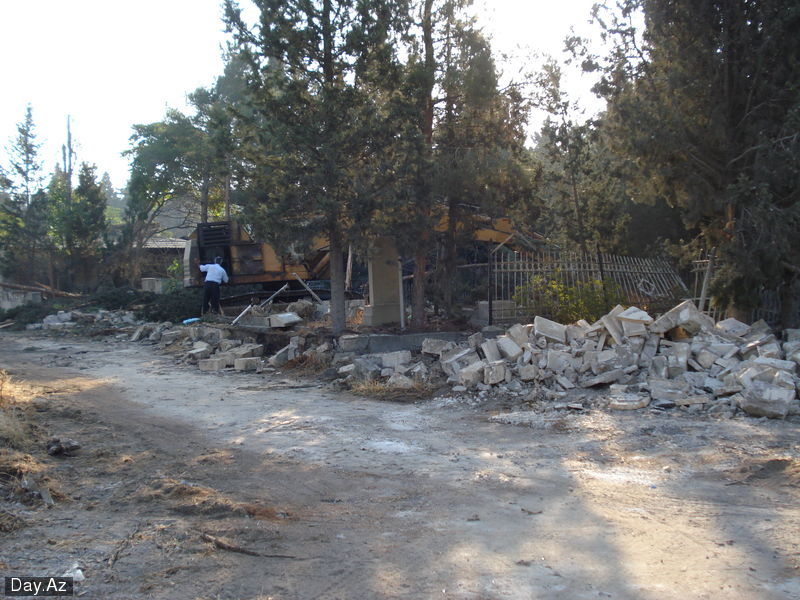
thrown around, and turned over by a powerful excavator
[back hoe tractor], which doesn't even spare the trees.
Before my eyes a large granite head stone was deftly and
easily lifted by the scoop, then after falling with a loud
boom, it burst into pieces. Some parts are still
preserved, but they will also get the same fate if the
relatives of those who are buried there don't come. But
there are only a few relatives who came. In 1.5 to 2 hours
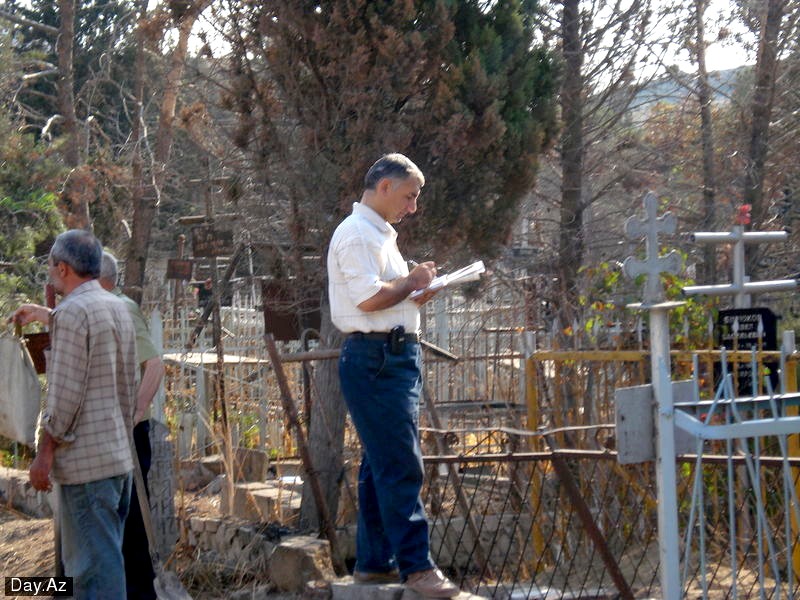
I saw only 2 families. I stood with them for a while.
The process of exhumation was a difficult spectacle to watch. I could hardly stand on my feet for the rest of the day. The relative of a deceased person (apparently a daughter) fainted. Her husband did not know whether to continue to instruct the workers, or to tend to her, or faint himself. Their adult son burst into tears. However, the workers were fairly quick — they rapidly opened the grave, dug out the rotten/moldy coffin, took out the terrible brown package which once was a person, then wrapped it in plastic, and put it into the car trunk and drove away.
There were no caskets. There's not enough of them, and there's not enough time to make them. Later I joined another family, who arrived at their grave site. I started a conversation with a short elderly gray-haired man. He had been moving relatives to Govsany cemetery for 2 days. The man was upset because he did not have enough time to get his distant relatives in another part of the cemetery — and their graves were leveled to the ground. He was also upset that there where no caskets, and he had to order caskets himself.
That's what's going on. The photographs are from the location of these events. These are the most innocent that I could photograph.
The process of exhumation was a difficult spectacle to watch. I could hardly stand on my feet for the rest of the day. The relative of a deceased person (apparently a daughter) fainted. Her husband did not know whether to continue to instruct the workers, or to tend to her, or faint himself. Their adult son burst into tears. However, the workers were fairly quick — they rapidly opened the grave, dug out the rotten/moldy coffin, took out the terrible brown package which once was a person, then wrapped it in plastic, and put it into the car trunk and drove away.
There were no caskets. There's not enough of them, and there's not enough time to make them. Later I joined another family, who arrived at their grave site. I started a conversation with a short elderly gray-haired man. He had been moving relatives to Govsany cemetery for 2 days. The man was upset because he did not have enough time to get his distant relatives in another part of the cemetery — and their graves were leveled to the ground. He was also upset that there where no caskets, and he had to order caskets himself.
That's what's going on. The photographs are from the location of these events. These are the most innocent that I could photograph.
September 12, 2007 — Armenian News PanARMENIAN.Net exposes Baku government lies in 2 languages:
- Azerbaijan feels right demolishing Christian cemeteries
- Азербайджан в своей стихии: В Баку уничтожают христианское кладбище
Chief engineer of Civil Service Trust Firuz Askerov said “the hearsay that bulldozers have razed to the ground the graves at the Nariman cemetery is false.” “They work to lay a way through the site of displaced graves,” he said.
According to him, “134 graves have been replaced [transferred] from the Nariman cemetery to the Govsany* cemetery.” Askerov said “besides Azeri graves there were also graves of Russians, Georgians, Tatars, Molokans, etc.” (However, he failed to mention about Armenians). He emphasized that “only those graves which lie on the territory covered by the contraction plan will be replaced,” APA reports.
Komsomolskaya Pravda newspaper reports that although local authorities assure of reinterment, photos in Internet show a complete dump. The photographers say the bulldozers just raze the graves to the ground depriving the relatives to rebury the remains.
The city administration says exhumation and reinterment is performed in accord with ethnic and religious traditions in the presence of relatives of the deceased. Meanwhile, the Jewish News Agency reports that “observance of Jewish traditions is restricted to the fact that grave-diggers throw the ashes into sacks and then give them to the relatives.”
* Spelled many ways — Goussan, Govsan, Govsany, Gousan, Gousany, Hoevsan, Hövsan, Hovsan — Govsany is a town about 12 miles west of Baku, along the coast.
September 12, 2007 — PanARMENIAN.Net
Russian Embassy in Baku receives numerous complaints about Christian cemetery demolition
"Every day the Russian Embassy in Azerbaijan received complaint about the decision of Baku authorities to replace the graves" with "a highway" ... cemetery director assures ... “No problems with the relatives of the deceased have emerged so far,” ... photos in Internet show a complete dump. "...grave-diggers throw the ashes into sacks and then give them to the relatives.”
Christian cemetery destruction can spoil Moscow-Baku relations
“The situation with the Nariman cemetery can have a negative influence on relations between our states,” said Vasily Istratov, the Russian Ambassador to Azerbaijan. He said the Embassy received plenty of complaints about the issue
This web page is getting lots of attention:
1428 page views from September 10 through 14, 2007.
More than any other news posted on Molokane.org
Links to this web page:
Sept 11, 2007 — Baku Molokan Cemetery Destroyed!
Sept 13, 2007 — Stop Destruction of Christian Cemeteries in Azerbaijan
Sept 13, 2007 — Nariman Cemetery, Armeniapedia.org Many e-mails came in thanking us for collecting this report, commenting on this disaster, and asking how to help.
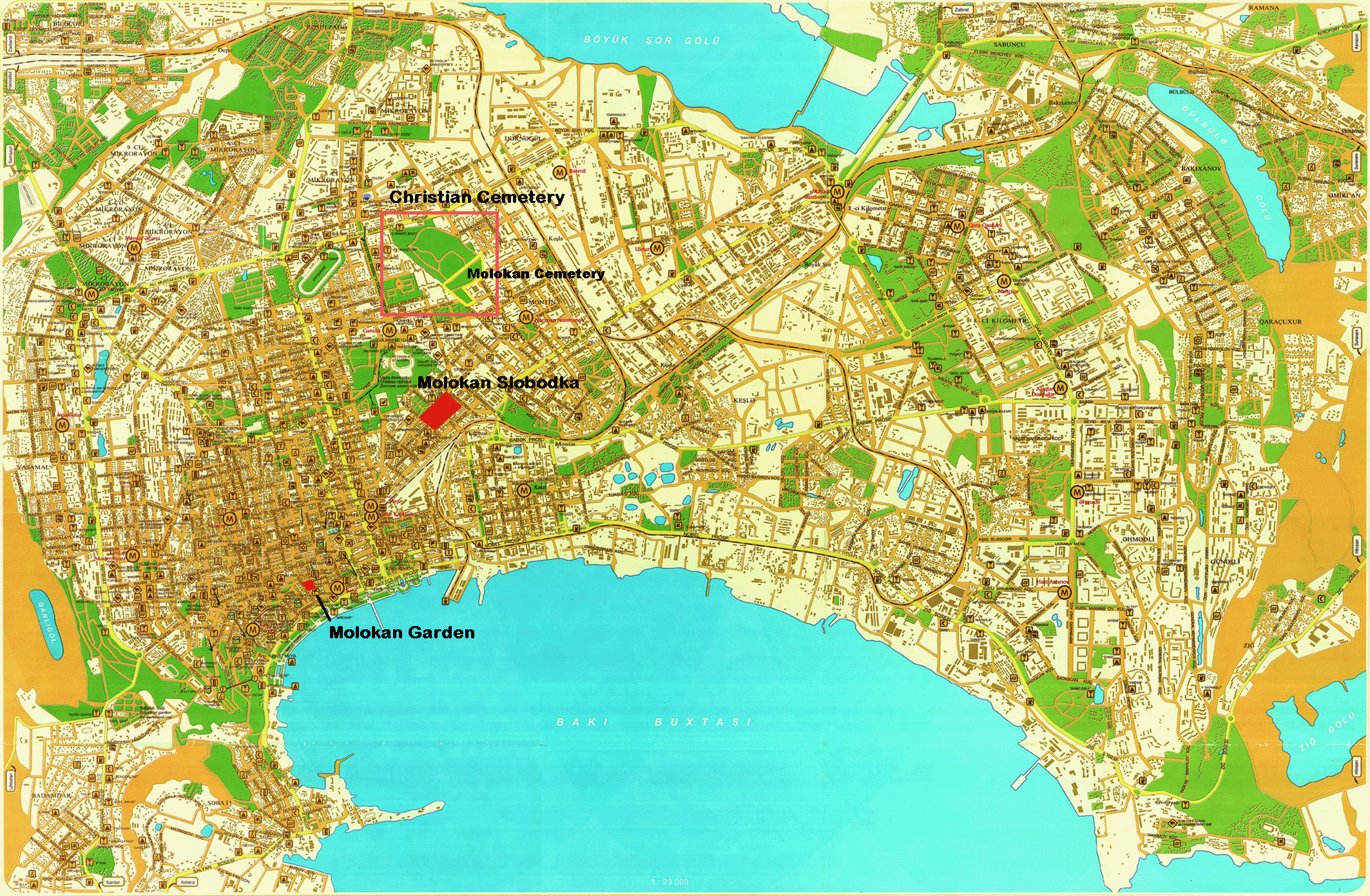
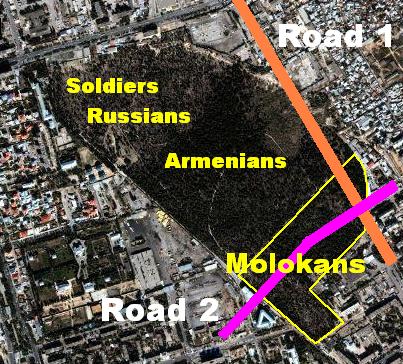
The "Christian" Cemetery is huge — 1 mile long, by a half mile wide — about 200 acres. Molokans occupy over 40 acres — 8 times the size of the Los Angeles cemetery on Slauson Ave. This cemetery was founded by Molokans and grew to accommodate other Christian faiths. The location of "Road 2" was provided by Katya Karagadayeva.
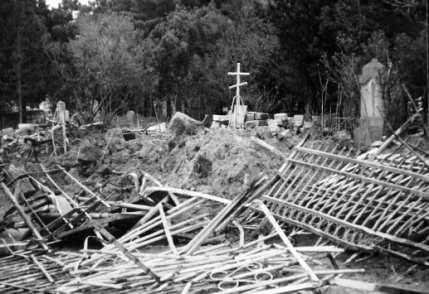
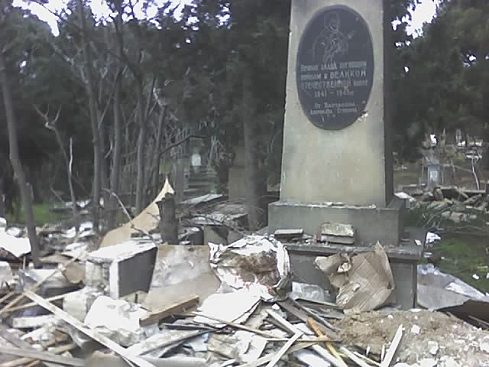
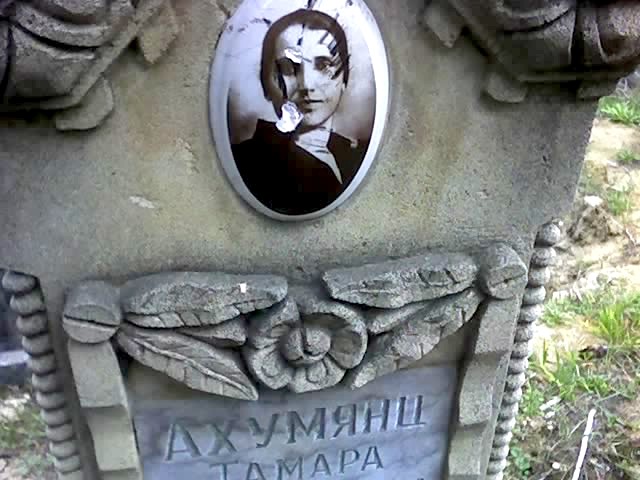
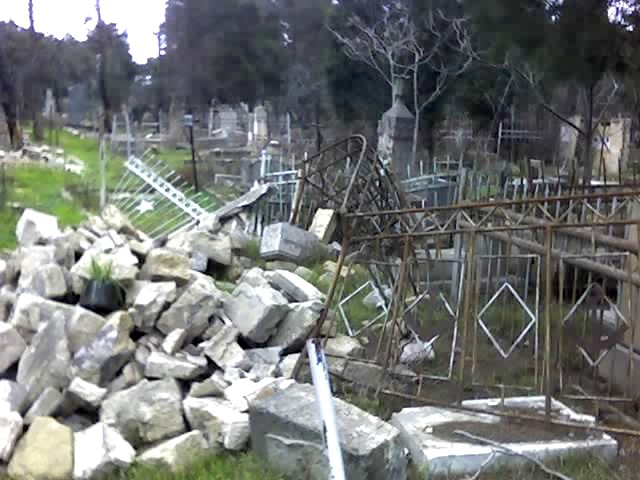
10 photos posted May 8, 2007 on the DPNI.org web site showed extensive damage to soldiers graves [Click on photos to enlarge]:
- В Баку варварски разрушили мемориал павшим в Великой Отечественной войне (фото)
- Translated: In Baku they barbarously destroyed World War II memorials for the dead (photo)
- More
photos
on Yandex.RU
 |
 |
 |
 |
 |
 |
 |
 |
 |
 |
- В городе Баку было разрушено древнее христианское кладбище
- Translated: An Ancient Christian cemetery was destroyed in Baku
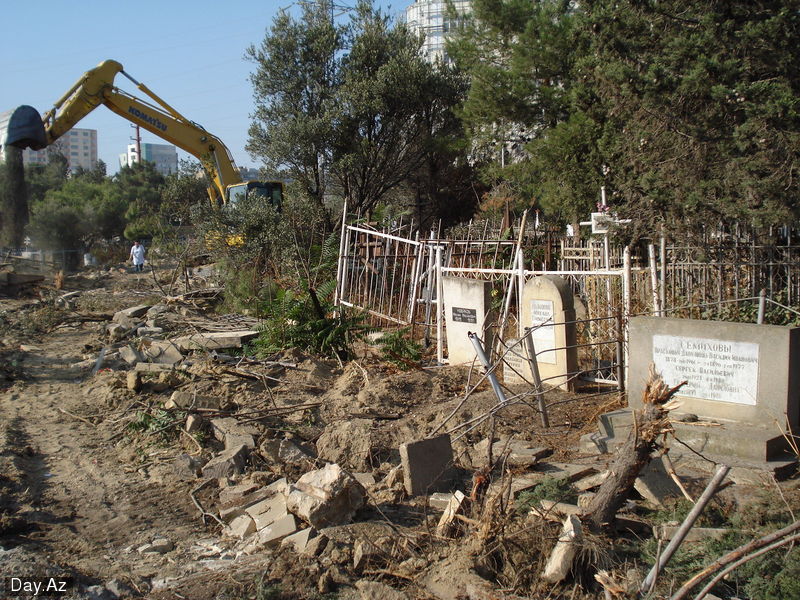
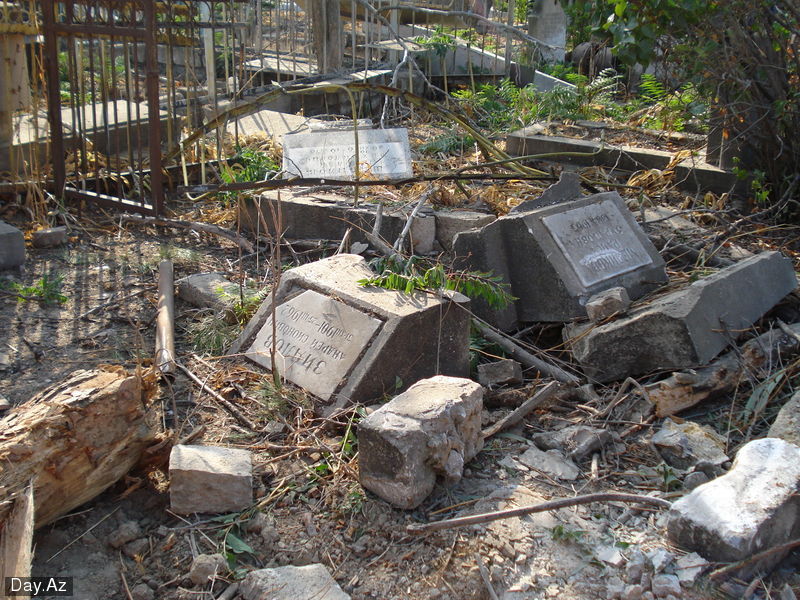
On September 4, 2007 a 25 picture photo story was posted on Day.AZ which appears to be taken in the Molokan section:
- Как перезахороняют на Наримановском кладбище
- Translated: How they are reburied at the Narimanov cemetery
 |
 |
 |
 |
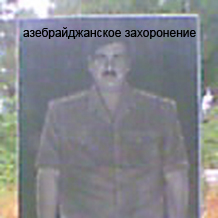
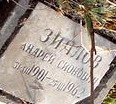 The photo above (enlarged and inverted, right) shows the grave of Andrei Sionovich Ziialov (1901-1962), whose name and grave design appears to be Molokan. |
|
 |
 |
 |
 |
 |
 |
 |
 |
 |
 |
|
 |
 |
 |
 |
 |
Reburials in Hovsan ciy cemetery 12 miles east Spelled: Goussan, Gousan, Govsan, Govsany, Gousany, Hoevsan, Hövsan, Hovsan |
|
 |
 |
 |
 |
 |
 |
| The following 7 photos may show the path of "Road 2" through the Molokan cemetery on September 10, 2007 — from Message #255 posted on the Day.AZ Forum by Buckingham. | 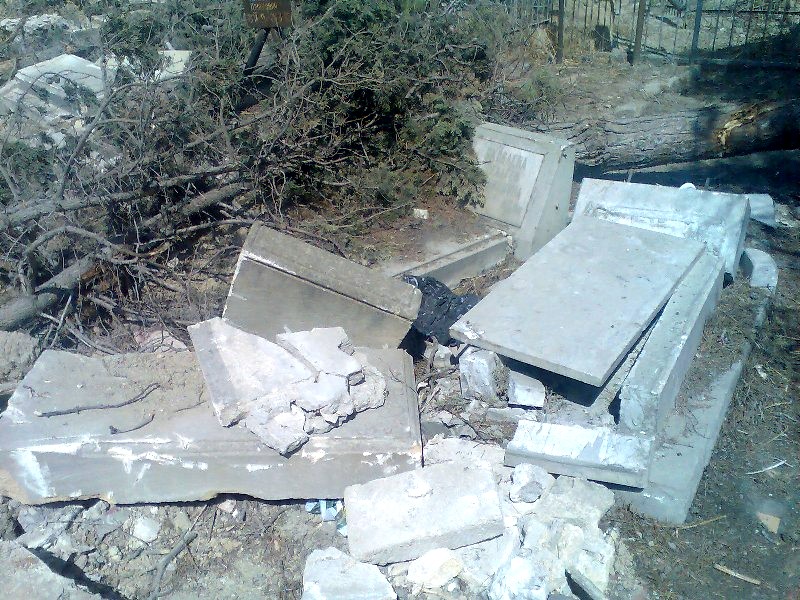 |
 |
 |
 |
 |
 |
 |
6 Ways to Protest
- E-mail, write, phone the Counsulate General of the Republic of Azerbaijan in Los Angeles:
- Phone, write the American Embassy in Baku, Azerbaijan
- Write the Mayor of
Baku: Hajibala Abutalibov, BAKU, AZ 1001, 4
Istiqlaliyyat Street. Phone: 99412 492 6311
- Write the President of Azerbaijan: Ilham Aliyev
- Write the director of the cemetery: Kiamran Mamedov, Director, Narimanov Cemetery, Baku, Azerbaijan.
- Post a message on
Day.AZ Forum: Снос
монтинского
кладбища, ваше отношение к этому вопросу?
[Destruction of the Montin cemetery, your attitude to
this question?] 340+ postings by Sept 2007.
September 14, 2007 — Roman Kudelin flew from Moscow to Baku to move his Molokan relatives out of the way of road construction. He only managed to save 3 of 5. He saw graves less than a month old destroyed.
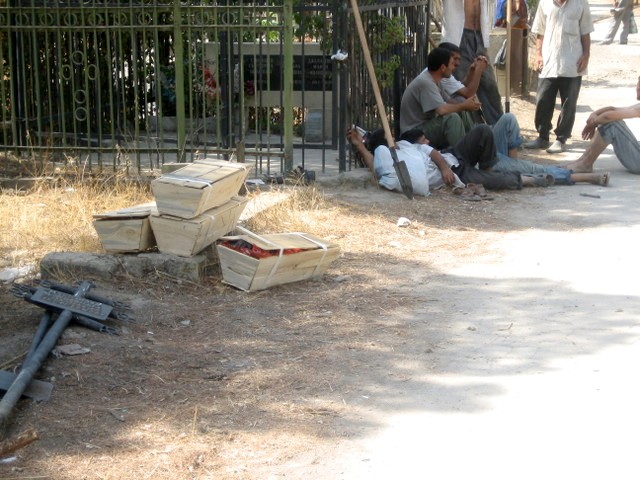 Kudelin photographed the area around his relatives graves
including these small wooden boxes, about 3 feet long and 1
foot wide, used to transfer decomposed bodies from the
cemetery. Most bodies are reported to be transported without
boxes.
Kudelin photographed the area around his relatives graves
including these small wooden boxes, about 3 feet long and 1
foot wide, used to transfer decomposed bodies from the
cemetery. Most bodies are reported to be transported without
boxes.September 14, 2007 — VIDEO on YouTube.com in 2 languages "Christian and jewish cemeteries destroyed in Az." (3 min., 21 sec.) (English, Russian) — a slide show alternating photo stills with news text and religious music.
This the "Azerbaijani policy of destroying Armenian cultural monuments and any traces of Armenians." Armenians blame the Azeri government for deliberate destruction of non-Azeri cultural places. Posted on December 14, 2006, "The New Tears of Araxes," (5-minute film) shows 1000s of ancient Armenian headstones flattened to the ground by the Azerbaijani authorities in Djulfa or Julfa (Jugha in Armenian), Nakhichevan, at the Iranian-Azerbaijani border south of Erevan, some as old as 1,500 years
September 15, 2007 — Armenian Reporter
Baku’s Armenian cemetery being destroyed
"...remains were shoved into plastic bags 'like garbage' and then handed to relatives who had to pay for the 'service.' "
September 17, 2007 — Mir-TV
В Баку перенесут 100-летнее христианское кладбище
A 100 year-old cemetery in Baky is removed
September 18, 2007 — Caucasus Conflict Portal
Yerevan. Vladimir Karapetian, a spokesman for RA foreign ministry, said Armenia condemns the destruction of a Christian (Narimanov) cemetery in Azerbaijan's capital city Baku by Azeri authorities. The cemetery had mainly Armenian and Russian graves, also of Georgians and Jews.
September 19, 2007 — Public Radio of Armenia
Armenia condemns destruction of Christian cemetery in Baku
September 19, 2007 — Yerevan.RU News
МИД Армении осуждает разрушение Наримановского кладбища в Баку
Armenian Foreign Ministry condemns the destruction of Narimanov cemetery in Baku ... "My father and mother, grandmother and many other ancestors are buried at the cemetery .... Apparently, vandals are looking for jewelry ..."
September 20, 25, 2007 — Caucasus Reporting Service posts in 2 languages:
- Agonizing Scenes at Razed Baku Cemetery: Relatives distraught as bodies exhumed to make way for new highway.
- Ланомерное уничтожение Бакинсого кладбища: Уничтожение кладбища с целью строительства на его месте новой трассы шокировало родственников похороненных там людей.
"RA Suggested that PACE Prepare Report on The Destruction of the Narimonov Cemetery in Azerbaijan"
January 1, 2008 — Trend NEWS, Azerbaijan
Christian Cemetery to be Moved from Baku through State Funds
Baku city mayor Hajibala Abutalibov headed a special commission he created at the end 2007. He announced that all graves in the Christian cemetery will be moved to build new highways. State funds will be used. Religious traditions with participation, if possible, of relatives of the buried will be observed. One part of the cemetery has already been moved. A special territory was allocated for the new cemetery in the Hovsan* settlement. Appeals submitted to the commission will be considered. The public will be timely informed of the work being carried out, full transparency is promised. [Few trust him.]
* Spelled many ways in English — Goussan, Govsan, Govsany, Gousan, Gousany, Hoevsan, Hövsan, Hovsan — a town about 12 miles west of Baku, along the coast.
January 16, 2008 — Today.Az
Graves planned to be carried away from Narimanov district cemetery. Regular works on carrying graves away from the cemetery of the Narimanov district of Azerbaijani capital will start on January 25, 2008.
Update: May 2, 2008
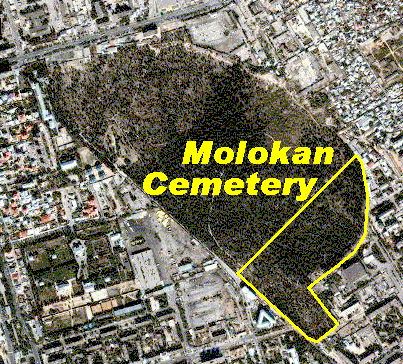
Before — 2006
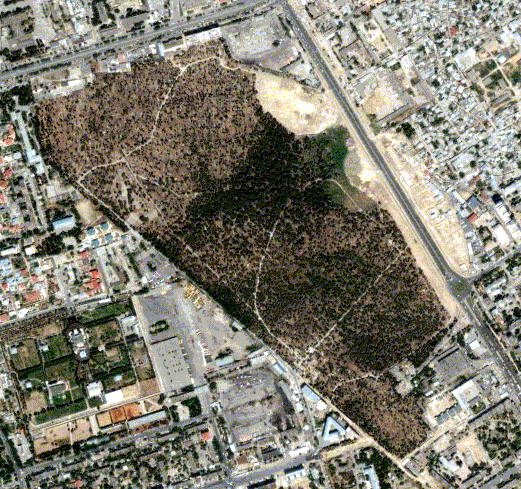
After — Late 2007
I am uncertain as to which "Aliev" street or streets are to be built next, because there are two streets called Aliev which end at the cemetery — "T. Aliyev Str." and "H. Aliyev Str." Both could be extended.
Click on images to enlarge. The street map (right) shows this formerly rural cemetery is now in a high traffic area near many major attractions — Hospital No.5, Hippodrome (horse race track), Ministry of Youth Sports, 3 sports arenas (Republican Stadium, and Ganjlik and Olympic Sports Complexes), 2 Metro stations (Gyanjlik and Narimanov subways ), 3 hotels, Elite Trade Center, Neon disco, Railroad, Agriculture Museum, and many commercial buildings.
Since most of the descendants of those buried have resettled or been chased out, most to Russia, it's politically easy to take the land. News reports the entire cemetery is "required" to be removed.
I have not yet found a published construction schedule in English or Russian.. News reports are somewhat confusing as to which streets are next. It seems that "Inglab" street, now named "H. Aliyev", is next, which will cut across the Molokans section.
Elshan Baloghlanov, the attorney Consular in Legal Affairs, Counsulate General of the Republic of Azerbaijan in Los Angeles, who I phoned last September, said today: (1) he is concerned because his grandmother is buried there along with other Azeris, (2) he believes new construction has stopped for now, (3) he has a packet of information in Azeri with a list of names of every grave moved so far which he will translate and share, and (4) that we should contact the local Narimanov district office in charge of cemetery relocation, in Russian, and he will provide the contact. He is busy with agricultural delegates from Azerbaijan until next week, when we will share information.
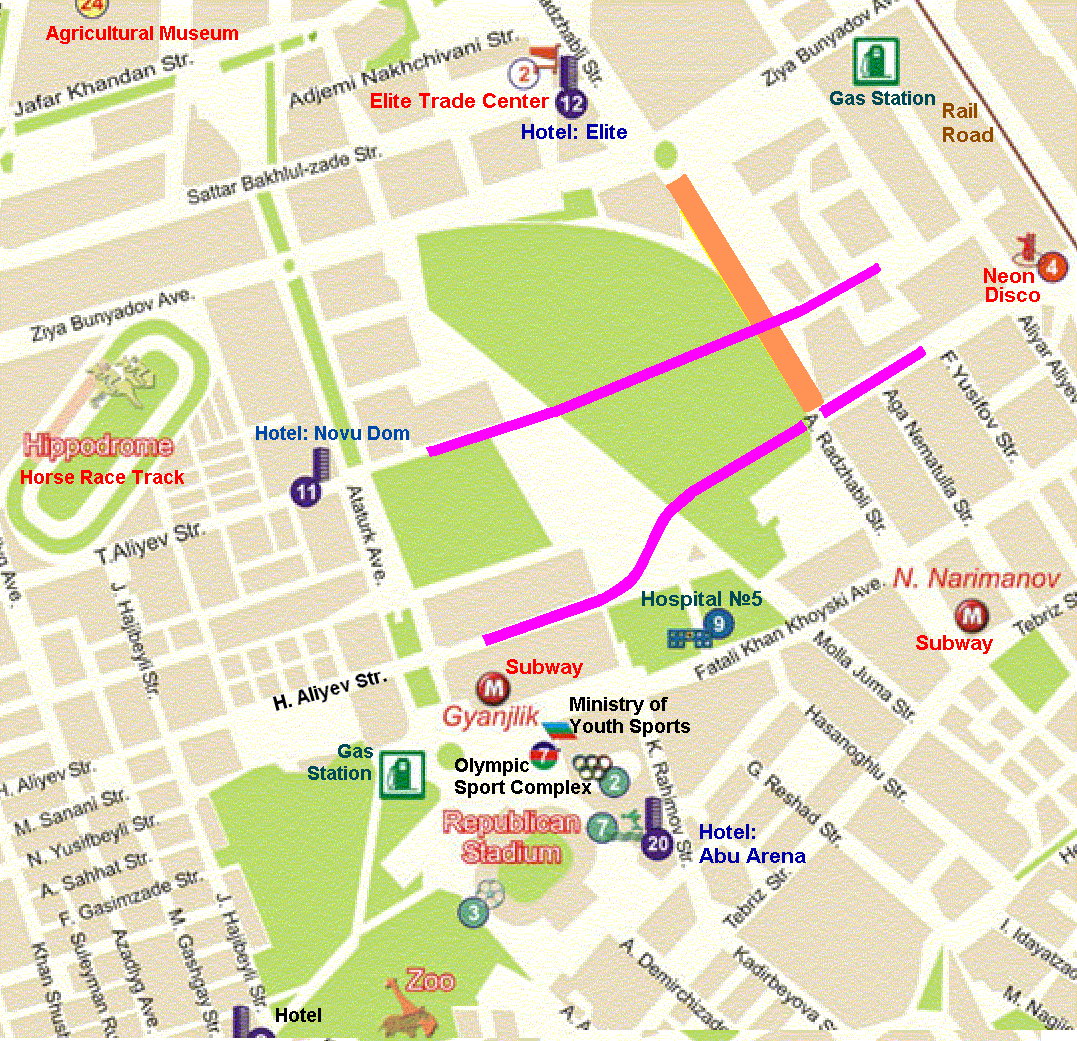
The street map (above) shows the new extension of "A. Radzhabli Str." as an orange line (Road 1) already through the cemetery. More streets (pink lines, above) may extend across the cemetery. It has been reported that "Aliev" street will be extended, but there are actually 3 streets with that name, and two end at the cemetery — T. Aliyev and H. Aliyev.
| Old street name | New street name |
| Inglab | Hasan
Aliyev
(since 1990) |
| Nagornaya 9th, Ingilab | Hasan Aliyev |
| Nagornaya 14th | Teymur Aliyev |
| Moskovskiy pr., Xatai pr. (part) | Heydar Aliyev (part) |
Update: June 18, 2009
Before — 2006
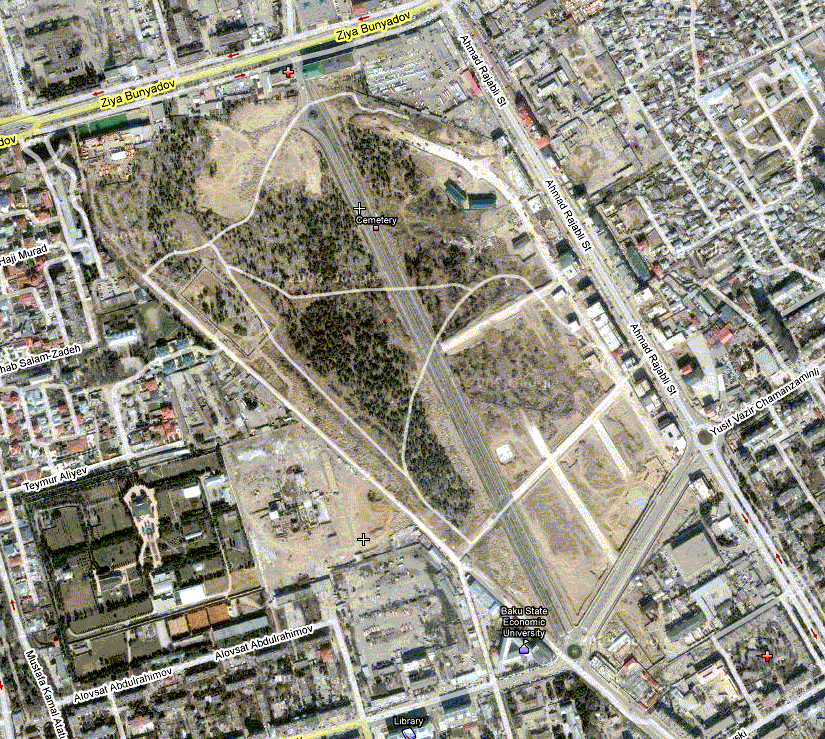
After — 2008

Come back for more updates
The Azerbaijan Embassy, Los Angeles, says they will furnish
a complete list of names of graves moved, to be posted.