18 Molokan Songs by Elena Ivanova ZvigintsevnaCherkasy, UkraineRecorded 1999 by the Christian Center for Science and Apologetics, Sevastopol, CrimeaХристианский научно-апологетический центр [Apologetics -- the explanation and defense of the Christian religion. See a full definition.] US Sponsoring agency: Teaching Ministries International, PO Box 1483, Snellville, GA 30078 USA |
||||||||||||||||||||||||||||||||||||||||||||||||||||||||||||||||||||||||||||||||||||||||||||||||
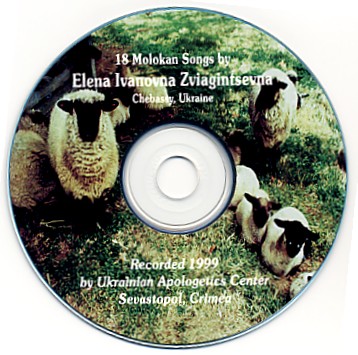 Quality enhancement by J.J. Samrain 2004 @ OT STudios, Whittier, California Reproduced and distriburted in America by J.J. Samarin (2004) |
These 18 Molokan
songs
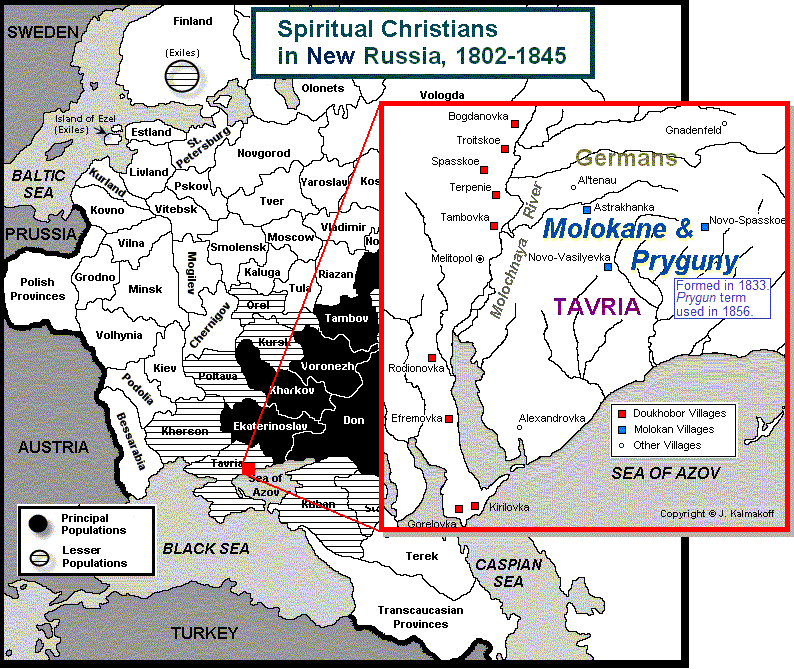
may be 200 years old. Half are still sung in America. The singer Elena Ivanova Zviagintsevna died in 2000. She lived in Cherkasy, central Ukraine, south of Kiev, and knew only a few Molokane during her life. She did not know there are currently Molokane in nearby Vinnitsia city, nor thousands east of Melitopol, Ukraine. She died a few years after this recording. Elena learned to sing from her elders who evidently did not mix with Molokane in south Ukraine, therefore her singing style is probably resembles the original form. Notably she does not sing protiazhnaia melodies, drawing-out her syllables as was done after Spiritual Christians — Molokane and Dukhoborsty — were resettled in the south Ukraine in the early 1800s. By singing a very slow style, slower than is common some folk songs, the Spiritual Christians learned they could camouflage their psalms from anyone listening and avoid punishment for exposing their faith to Orthodox. In 1999 Elena Ivanova shared her Molokan heritage with a Christian organization she met on the street. The missionaries knew nothing about Molokane but were so impressed with her singing knowledge that they wanted to perserve these Russian Christian songs of antiquity. They digitally recorded her singing and produced a CD which was once listed for sale on their Russian audio web page — 6. Духовные песни молокан (60 мин). We ordered a copy and paid for another 100 copies to be delivered to the 3 Molokan congregations where thousands of Molokane still live today in south Ukraine east of Melitopol — Astrakhanka, Novo-Vasilyevka, Novo-Spasskoe. |
|||||||||||||||||||||||||||||||||||||||||||||||||||||||||||||||||||||||||||||||||||||||||||||||
| Los
Angeles area, Elder Singer James John Samarin was given an original
disk for examination. With other singers he determined
that 9 of
these 18 songs correspond closely to text and melodies of the American
Dukh-i-zhin' pesennik,
and one is a Bible verse. After more than 150 years
of separation, more than half of these songs are also preserved in the
US. Samarin asked if he could reproduce the CD and give them away
with the label shown above.Thanks to Elena Ivanova and to the
Apologetics Center in Sevastopol,
Crimea for their historic preservation; and to James John Samarin and
associates for
analysis and generous reproductions. The original files (16-bit, stereo, 44100 Hz, .wma) are compressed to RealMedia and MP3 formats (16-bit, mono, 22050 Hz) — .rm (95%) and .mp3 (90%). Players for these formats are probably installed on your computer. Listen to the selections by clicking on the file-types (RM or MP3) in the column titled "Listen", below right. The file size is also shown. If the selections do not play automatically, then you probably need to download the free software from: RealMedia, and/or MPEG. In the beginning, before the first song, Elena Ivanova recites an introductory prayer: "Благослови Господи исполнять по твоёй воле" [God bless me to perform by your will]. Notice that in contrast to this clear Ukranian-style the Caucasus-trained singers, like American Molokane, sing much more "drawn out". By stretching the song vowels [protazhniia] non-Molokans nearby on the street would not easily understand the words which would get the singers into legal trouble for sharing their faith with others, especially the Orthodox. Doukhobors also sing very "drawn out" to camoflage their songs. Find more details and examples in The Molokan Heritage Collection: Volume IV: The Origin of Molokan Singing, by Dr. Linda O'Brien-Rothe.] |
||||||||||||||||||||||||||||||||||||||||||||||||||||||||||||||||||||||||||||||||||||||||||||||||
Total time: about 58 minutes
*
Words
vary somewhat from the American Sionskii
Pesennik (Songbook of Zion).
|
||||||||||||||||||||||||||||||||||||||||||||||||||||||||||||||||||||||||||||||||||||||||||||||||
Russian Molokan Church Service recorded in San Francisco in 1938
Back to Molokane and Pryguny Around the World