 Armenian
International
Magazine Glendale, California
Armenian
International
Magazine Glendale, CaliforniaApril 2002, Volume 13, Issue 3, page 46
For Christ and Cabbage:
Molokans** Preserve Their Way of Life
by Mark GrigorianRussian Tsar Nikolai I in 1830 signed a decree prohibiting* Molokans** to live in the central areas of Russia and allowing them to resettle in Transcaucasus. This is how [Spiritual Chrisitans] Molokans [and Dukh-i-zhizniki] appeared in Armenia.
Molokans [and Dukh-i-zhizniki] live in harmony with nature. They preserve not only the fields, but also the forests. The Fioletovo Molokans [and Dukh-i-zhizniki] collect raspberries. Molokans in other places collect wild pears, sea-buckthorn, dog rosá. Their jams and compotes made from forest berries are fantastic.
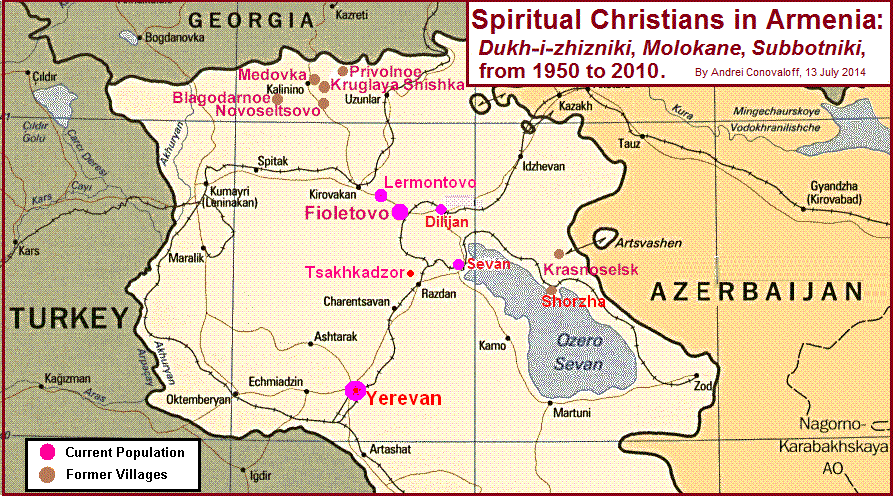
The main product of Fioletovo is cabbage. They sell it and pickle it. Molokan** sauerkraut was highly valued in the Soviet Union. The Molokans [and Dukh-i-zhizniki] of Fioletovo say they exported sauerkraut to Russia, Ukraine, even Turkmenistan.
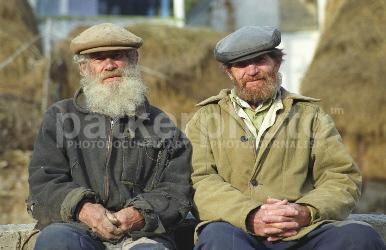
Two Molokan [Dukh-i-zhiznik] men sit on a wall in Fioletovo, Armenia
[This Photo appeared in the article. The man on the right may be Ivan Zadordin "Montior" (nickname: "Electrician", монтёр), Fioletovo, Armenia.]
Original caption:
LERMONTOVO VILLAGE, ARMENIA — Two Ivans, two friends- Russian villagers looked like that one hundred years ago.
All photos and captions are from 138 photos in Photo Story, Pakerphoto, by Ruben Mangasaryan (14 Nov 1999 - 15 Dec 2002 — Molokans [and Jumpers] are ethnic Russians and Christian sectarians. In Armenia they live in Fioletovo village, which looks like a typical village in central Russia: birches, Russian houses, golden-haired children running around with everybody speaking Russian. The villagers bake bread in old-fashioned Russian ovens, whip cream and make butter in pakhtalkas (traditional Russian tools to churn butter), make sauerkraut and plough with horses. Their main trade is cabbage and they are busy with it the whole year. Cabbage is gathered in autumn and sold in winter. There is only one telephone for the whole village and less than a dozen of TV sets.
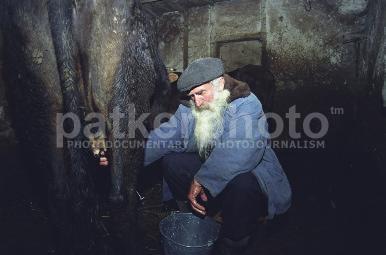
Alexei Yakovlevich Zadorkin is milking cows.
(23 Mar 2001, Fioletovo village)
Mikhail Mechikov builds hotbeds on his farmland for cabbage, which he seeded in early April. The hotbeds look like this: two to three square meters of ground are fenced by low wooden or metal skirting. The hotbeds are covered by a metal net, so that birds do not peck the seedlings. Near one side is a roll of cellophane, which is unrolled to cover the gentle cabbage sprouts when the temperature falls. Each household has three or four such hotbeds.
Nearby, Mechikov has sown alyssum. Each sprout of small leaves is covered by a large glass jar, under which it will grow. Carrots also grow nearby — Mechikov has constructed a special awning to shade them from direct sunlight, rain or hail.
"Each stone is familiar to me for 20 kilometers from here," says his cousin Ivan Mechikov. "I know how each tree grows, the quality of each spring."
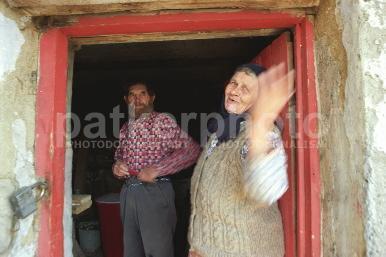
Ivan Biryukov and his wife. (14 Nov 1999, Fioletovo village)
Ivan Birukov, a small man of 55, says it is just a "trifle" to dig up 700 square meters of ground.
Molokans [and Dukh-i-zhizniki] live in harmony with nature. They preserve not only the fields, but also the forests. The Fioletovo Molokans [and Dukh-i-zhizniki] collect raspberries. Molokans [and Dukh-i-zhizniki] in other places collect wild pears, sea-buckthorn, dog rosá. Their jams and compotes made from forest berries are fantastic.
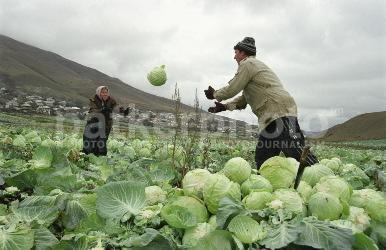
Collecting cabbage in Fioletovo. That is the responsibility of the whole family. (30 October 2001)
The main product of Fioletovo is cabbage. They sell it and pickle it. Molokan sauerkraut was highly valued in the Soviet Union. The Molokans [and Dukh-i-zhizniki] of Fioletovo say they exported sauerkraut to Russia, Ukraine, even Turkmenistan.
The disintegration of the USSR cut off the roads and railways connecting Molokans [and Dukh-i-zhizniki] to their former markets. Tatyana, Mechikov's wife, says: "Our market is very narrow now. We can take cabbage and sauerkraut only to Yerevan and Tbilisi in Georgia."
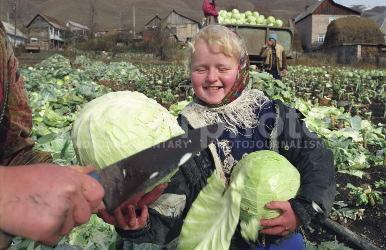
Yulia Zadorkina is helping her family to collect cabbages.. (30 October 2001, Fioletovo village)
However, the Molokans [and Dukh-i-zhizniki] adapted to the new conditions. They started to export their know-how. Families go to Krasnodar and Stavropol regions in Southern Russia, where they buy barrels and cabbage. Then they pickle and sell it.
"Though it is not tasty there," they say, "the cabbage is different, because of the water. The water in Armenia is better."
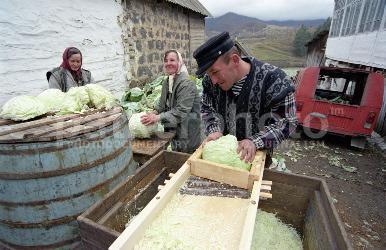
Viktor Chechev is preparing the sauerkraut in his backyard with his mother Lyuba Checheva and aunt Vera Novikova. (30 October 2001)
To make real Molokan sauerkraut, you should chop then wash the cabbage and add carrot after it is pared and macerated ("otherwise it will color the cabbage"). For a bucket of cabbage, a handful of carrots and a little bit more than that of salt are needed. A black pepper and bay should be added. In eight to ten days, the sauerkraut is ready.
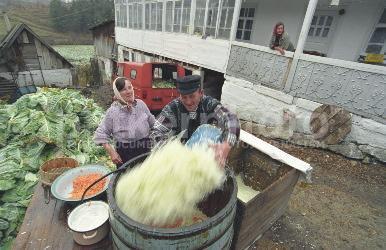
Viktor Chechev is preparing the sauerkraut in his backyard with his mother Lyuba Checheva and aunt Vera Novikova. (30 October 2001)
Very tasty.
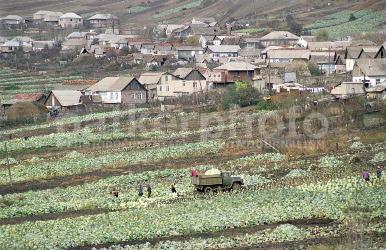
Cabbage fields in Fioletovo (30 October 2001)
When the lambs are small, they cannot find their homes So when the flock comes back from the pastures, the whole village meets it at the outskirts Everyone tries to find their lambs and drive or simply carry them home. To avoid confusion, the lambs are marked with bright paints: red, yellow, green, blue.
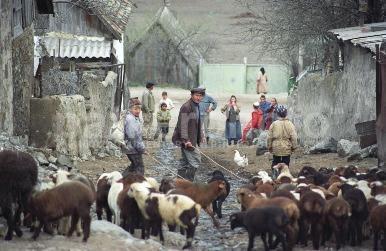
Meeting the lambs (23 Mar 2001, Fioletovo village)
The villagers enjoy the show, laughing and shouting, but within minutes the turmoil is over. The quiet rural evening returns to Fioletovo, a village in northern Armenia that belongs to Molokans [and Dukh-i-zhizniki] — ethnic Russians, sectarians, exiled to Transcaucasus at the beginning of the 19th Century.
The Molokans sect broke away from the Russian Orthodox Church in the 17th Century. The Molokan [and Prygun] heresy became widely known in villages of Southern and Central Russia, a situation that became intolerable to the ruling powers.
Russian Tsar Nikolai I in 1830 signed a decree prohibiting* Spiritual Christians, including Molokans, to live in the central areas of Russia and allowing them to resettle in Transcaucasus. This is how Molokans [and Dukh-i-zhizniki] appeared in Armenia.
At the beginning of the 20th Century, the Molokan [and Dukh-i-zhizniki] villages in Armenia numbered more than 20. The town of Sevan was a Molokan [and Subbotniki] village called Elenovka; today's famous mountain resort Tsakhkadzor used to be Konstantinovka; another resort, Dilijan, incorporated Molokan [and Dukh-i-zhizniki] villages of Golovino and Papanino.
But now Fioletovo is the only remaining Molokan [and Dukh-i-zhizniki] village. Whereas there were once 50,000 Molokans [and Dukh-i-zhizniki] in Armenia, there are now only about 5,000, including 1,100 in Fioletovo.
[Dukh-i-zhizniki] Alexander Morozov does not have a TV set for religious reasons. The faith does not ban TV, but the presbyters (spiritual and religious leaders) do not recommend it out of moral considerations.
"I have a radio," says Morozov, "but it is no good to listen to radio. True believers should read the Bible and follow the line of self-perfection. When the radio is on, it tells news, plays music...One can listen for hours. That's no good."
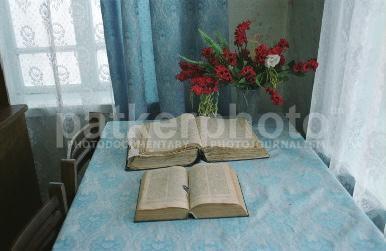
Prayers books waiting to be read by Molokan believers.
(15 Dec 2002, Fioletovo village)
Some watch television — to escape the presbyters' wrath, they hide their TV sets in wardrobes.
Strictly speaking, Molokans [and Dukh-i-zhizniki] should not drink alcohol or smoke. However, the younger generations break these taboos. There are two retailers' shops in the village where one can unofficially get a drink.
"Every Sunday they gather in the middle of the village, drink and fight in the evening," says Gohar, an Armenian seller at the competing shop.
Molokans [and Dukh-i-zhizniki] who live in the United States cannot believe there is no Internet access in Fioletovo. The reality is harsher still — there is only one telephone in the whole village.
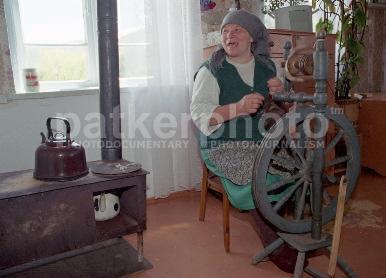
Michael Mechikov's wife making thread with an old samopryakha [self-powered spinning wheel] (23 Mar 2001, Fioletovo village)
Signs of 19th Century life are visible in the households. Sewing machines stand next to ancient spinning wheels. Molokans [and Dukh-i-zhizniki] do not buy food in shops, so there are no food shops in Fioletovo. Everything is prepared or cooked at home: bread, cheese, sour cream. Butter is churned with a pakhtalka an old Russian tool.
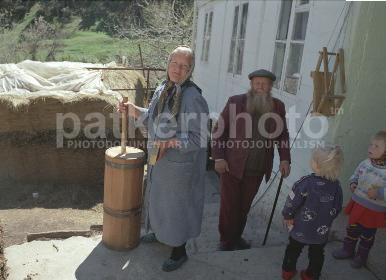
Pakhtalka is used to make butter. Michael Menshikov with his wife Maria Minosueva and grandchildren in his backyard. (23 Mar 2001, Fioletovo village)
Top of next
column ^
—————————
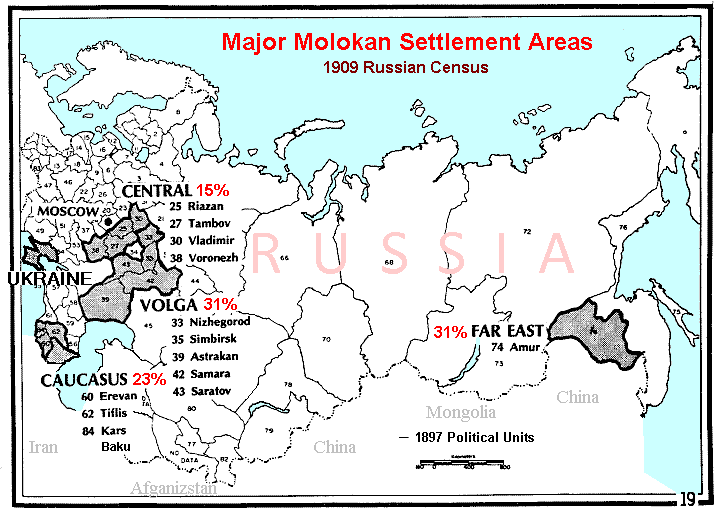
* By 1987, 15% of Molokane and no Dukhizhizniki remained in Central Russia. These are citizens in Russian who broke the law by refusing to be Orthodox. The Edict of 1830 aimed to separate sectarians from Orthodox and populate new Russian territories by offering sectarians voluntary relocation to the periphery of the Russian Empire, with land and financial incentives. The most "infectious" and "harmful" sectarians were forced into the military, or to migrate. Some migrated illegally (to escape debt) while others were not allowed to migrate (those with Orthodox family). Many pretended to be Orthodox. Find details in Breyfogle, Heretics and Colonizers, pages 1-2, 17-19, 70, 308-9; and his Ph.D. thesis pages 25-78.
** Here "Molokan" is mistaken as an ethnic group or nationality. The "Molokan" brand of pickled cabbage is mostly sold by the majority Dukhizhiznik denomination in Fioletovo, and members who moved to Russia.
* By 1987, 15% of Molokane and no Dukhizhizniki remained in Central Russia. These are citizens in Russian who broke the law by refusing to be Orthodox. The Edict of 1830 aimed to separate sectarians from Orthodox and populate new Russian territories by offering sectarians voluntary relocation to the periphery of the Russian Empire, with land and financial incentives. The most "infectious" and "harmful" sectarians were forced into the military, or to migrate. Some migrated illegally (to escape debt) while others were not allowed to migrate (those with Orthodox family). Many pretended to be Orthodox. Find details in Breyfogle, Heretics and Colonizers, pages 1-2, 17-19, 70, 308-9; and his Ph.D. thesis pages 25-78.
** Here "Molokan" is mistaken as an ethnic group or nationality. The "Molokan" brand of pickled cabbage is mostly sold by the majority Dukhizhiznik denomination in Fioletovo, and members who moved to Russia.
Spiritual Christians Around the World