— 26 июля 2005 года — 26 июля 2005 года |
Novye Izvestiia [New News] — July 26, 2005 | ||
| Similiar
versions
also posted at Interfax-Religion.ru,
Protestant.ru,
BibleLamp.ru,
JesusChrist.ru,
and photos at TASS
Photo. |
|||
| "Двести
лет без места. На Ставрополье проходит юбилейный съезд христиан-молокан" |
"Two hundred years
without a place. The Christian-Molokan anniversary convention is being held in Stavropol province" |
||
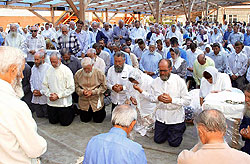
| В
станице Кочубеевка Ставропольского края проходит Всемирный
съезд духовных христиан (молокан), в котором участвуют
представители общин из всех регионов России, а также из
Австралии, Америки и Канады. Молокане – одно из течений
"русского протестантизма", существующее с середины XVIII
века. По миру рассеяно 300 тыс. молокан, отмечающих
сегодня в Кочубеевке 200-летие дарования им свободы
вероисповедания. |
The World-wide Convention
of Spiritual Christians (Molokan) is being held in the
village of Kochubeevskoe
in Stavropol' province. Representatives of congregations
from all regions of Russia participated, and also from
Australia, America and Canada.* Molokans are one of the branches of
"Russian Protestantism" which existed since the mid-1700s.
There are 300,000 Molokans distributed around the world.
In Kochubeevskoe today they are celebrating the 200th
anniversary granting them the freedom to worship. [From San Francisco the
Peter W. Loskutoff family attended, plus a cousin from
Whittier. No other foreign participants.] |
||
|
|||
| Едва
появившись на свет, молоканское движение всю вторую
половину XVIII века подвергалось жестоким преследованиям
властей, верующие были принудительно выселены в крымские и
ставропольские степи, в Сибирь, а позднее в Закавказье. В
настоящее время самые многочисленные группы молокан – до
40 тыс. человек – живут в Тульской области и
Ставропольском крае. Повсюду, куда их ни гнали, они смогли
не только выжить, но и создать процветающие поселения.
Одно из них – село Кочубеевка, где в эти дни и проходит их
Всемирный съезд. Он приурочен к 200-летию дарования им
императором Александром I свободы вероисповедания. Однако
программа не исчерпывается молитвами и концертами
песнопений. Молокане всерьез озабочены своей
разобщенностью, старением общин, а главное –
предубеждением властей. |
In it's infancy the Molokan
movement throughout the second half of the 1700s was
severely prosecuted by the authorities. Believers were
compulsorily moved to the Crimean and Stavropol steppes,
to Siberia, and later to Transcaucasia.* Now the most numerous groups
of Molokans, up to 40, 000 people, live in Tula and
Stavropol provinces. Everywhere they were driven to, they
not only survived but also created prosperous settlements.
One of them is the village of Kochubeevskoe where their
World-wide congress is being held this week. It is the
occasion of the 200 anniversary of Emperor [Tsar]
Alexander I granting them the freedom to worship. However,
the program agenda will not just be prayers and concerts
of religious songs. Molokans are seriously worried about
separating [disintegration, lack of cohesion], the aging
of congregations, and the main concern is the bias of
authorities. *
[About 85% voluntarily
resettled to New Russia (now south Ukraine) and to the
Transcaucasus due to grants of land, military and tax exceptions,
and fewer restrictions on religion. For details, read Breyfogle.] |
||
| Накануне
съезда
молокане обратились с письмом к Владимиру Путину, поведав
о том, как восьмой год обивают пороги столичных
начальников. Еще в ноябре 1999 года правительство Москвы
выделило им два участка в Южном административном округе,
однако районная управа дважды отказала общине в
строительстве молитвенного дома и культурного центра.
Основание – подписи жителей района, выступивших против
строительства. Кто-то нашептал аборигенам, будто молокане
– "тоталитарная секта", завезенная к нам из Штатов.
Молокане пожаловались Юрию Лужкову, и мэр трижды брал дело
на "особый контроль". В конце концов общине выделили
участок, на котором находится ветхое здание бывшей
ветлечебницы. Участок был зарезервирован, руководство
общины утвердило проектное предложение для строительства,
израсходовав 150 тыс. рублей. Но тут – новый поворот:
принимая новое здание ветлечебницы, городской голова
распорядился передать старое (вместе с участком) клубу
"Юный зоотехник". |
The day before the congress, the Molokans called to the attention of Vladimir Putin in a letter telling how the managers of the capital have been giving them the run-around [obivaiut porogi] for 8 years. In November 1999, the government of Moscow allocated two parcels of land to them in the Southern administrative district, but the regional authority twice denied the congregation to build a church [prayer house] and cultural center. The basis was signatures of local residents which opposed the construction. It's as if someone whispered to the locals that the Molokans are a "totalitarian sect" imported from the [United] States. Molokans complained to Iury Luzhkov [Moscow mayor], and the Mayor put the matter on "special attention" three times. Eventually the congregation was allocated a parcel of land on which there is a dilapidated building, formerly a veterinary clinic. The parcel of land was reserved, and the leaders of the congregation approved the design plan for construction spending 150,000 roubles [US$ 5,000]. But here's the new twist, while dedicating a new veterinary clinic [nearby], the head of the city transferred the old building together with the land to the "Young Livestock Specialist [Zoo Technician]" club. [See the original letter which notes that Muscovites don't know the difference between their imported and indigenous religions.] | ||
| "Диву
даешься, – пишут молокане президенту, – 200 лет назад три
неграмотных мужика из Тамбовской и Воронежской губерний –
Мотылев, Лосев и Журавцев – с прошением, которое составил
сын священника Семен Уклеин, пошли в Санкт-Петербург к
императору всея Руси Александру I и 12 июля 1805 года
передали ему Прошение. Император собрал Сенат и 22 июля
1805 года издал указ "О свободе вероисповедания молокан и
духоборцев", то есть всего за 10 дней решил конституционно
важный вопрос! А попробуйте вы сейчас попасть на прием к
префекту ЮАО!.." |
The Molokans write to the President: "Just wonder how 200 years ago, three illiterate peasants from Tambov and Voronezh provinces — Motylev, Losev and Zhuravtsev — with a petition written by the son of our presbyter Simeon Uklein, went to Saint Petersburg to the Tsar, Emperor of All Russia, Alexander I. And on July 12, 1805 they submitted the Petition. The Emperor [Tsar] called the Senate, and on July 22, 1805 issued a decree "About a freedom of worship for Molokans and Dukhobors". In just 10 days an important constitutional problem was solved. And now try to get an appointment with the Administrator of the South District!" | ||
| Ситуация
плачевна
еще и потому, что подавляющая часть членов московской
общины – беженцы из Азербайджана и Армении. Некогда
процветавшие молоканские села на Кавказе – Фиолетово,
Семеновка, Александровка – ныне обезлюдели. По словам
председателя совета общины Якова Евдокимова, в других
регионах страны, куда переселились с Кавказа молокане,
власти не допускают проволочек при выделении им участков и
помещений. Столица же, гордящаяся статусом
многонационального мегаполиса, похоже, претендует стать
городом одной-единственной конфессии. |
The situation is also
pitiable because a majority of the members of the
Moscow congregation are refugees from Azerbaijan and
Armenia. At one time the Molokan villages in Caucasus
prospered, now Fioletovo*, Semenovka, Aleksandrovka are deserted.
According to the elder chairman of the congregation, Iacob
Evdokimov [a refugee
from Armenia], in other regions of the country
where Molokans have moved to from the Caucasus, the
authorities do not stall the allocation of parcels of land
or buildings. The capital proudly calls itself a
multinational metropolis, but it appears that it will
become a city of one faith [Orthodox]. *[But Fioletovo
still has 500+ Spiritual Christian households, mostly Dukhizhizniki
with 4 congregations, and one Molokan congregations.] |
||
| 100-летие
дарования
духовных свобод старообрядцам, еще недавно таким же
изгоям, послужило сигналом для того, чтобы власти наконец
признали их за своих. Молоканам подобная перспектива,
похоже, не светит. Иначе с чего бы им проводить свой
Всемирный съезд не в столице России, где расположен Совет
союза их общин, а в станице Кочубеевка? |
The 100th anniversary
granting spiritual freedom to Old Believers [Old
Ritualists], until recently not accepted by society, has
served as a signal that the authorities have finally
recognized them. But similar prospects won't happen
to [shine on] the Molokans. Otherwise, why don't they hold
the World-wide congress in the capital of Russia [Moscow]
where the Council of the Union of their congregations is
located, instead of the village of Kochubeevskoe? |
||
| МОЛОКАНЕ – ОТ СЛОВА "МОЛОКО" |
MOLOKANE – FROM THE WORD "MILK" |
||
| Молокане,
отрицающие
церковную иерархию, монашество и почитание икон, обязаны
своим появлением православному расколу. В основных чертах
их богослужение и уклад жизни сродни тому, что можно
видеть у староверов – "беспоповцев". Основа вероучения
молокан ( * Эти термины описывают секты как прыгуны (веденцы значит: провидец, визионер). |
Molokans formed during the
time of the Orthodox schism [split] and rejected the
church hierarchy, [paid] clergy [monasticism], and
reverence for icons. In general their worship service and
way of life is similar to what one might see among the
"Priestless Old Ritualists" [Staroveri "bespopovtsev"]. The basis of Molokan
dogma ( * These terms describe sects similar to Pryguny (Jumpers). |
||
| Михаил
ПОЗДНЯЕВ
– "Известия" – 26 июля 2005 г. |
Michael Pozdniaev –
"Izvestiia" [News] – July, 26th, 2005 |
||
|
|
|||
| 200-летнем юбилее Духовные христиане — вокгуг света |
200th
anniversary Spiritual Christians Around the World |
||